KSPR post: Unexpected Neighbor

13 05 2011

Posted a few excerpts from the first chapter of my first novel, Unexpected Neighbor, at Knotted Spring Press Review.

When I finally manage to format it all for SmashWords, I’ll let y’all know.

And, hey, if you know anyone who might be interested in publicizing their work, send ’em my way. Yeah, it’s all still very beta, but why not leap and look at the same time?


Chutzpah!

12 05 2011
From the New York Times Caucus blog:

May 11, 2011, 1:16 pm

Republicans Decry Tactics the Party Used in 2009

By JENNIFER STEINHAUER

Yes, it’s true, Republican House freshmen say, our party did help storm town-hall-style meetings to protest changes in the Medicare plan during the debate over the health care overhaul. But they would appreciate it if Democrats did not take that page from their playbook.

On Wednesday, 11 newly elected representatives held a news conference outside the Capitol to promote a letter sent to President Obama and signed by 42 freshmen Republicans asking him “join us to stop the political rhetoric” surrounding their Medicare proposal. In asking the president to work with them to untangle the issues facing massive entitlement programs, the letter further implores Mr. Obama to “condemn the disingenuous attacks and work with this Congress to reform” the programs.

Repeatedly, the members called for a “fact-based conversation” and criticized Democrats for filling town-hall-style meetings with political operatives and citizens who complained – often loudly – about the Republican proposal on Medicare at constituent meetings over the Easter recess. The Republican proposal would convert Medicare into a program that subsidizes future retirees in private insurance plans.

The freshmen conceded that Republicans used similar organized tactics during the health care debate over the summer of 2009, when Tea Party organizers and Republican groups spoke out against the overhaul.

“I’m not going to defend anything in the past,” said Representative Adam Kinzinger, a freshman from Illinois, who led the news conference calling on Democrats to stop their public critique of the plan. “Let’s get past the past.”

Representative Nan Hayworth of New York, a former doctor, said it was time to “have a civilized conversation” and her class was “standing ready to work with the president.”

. . . .

Here’s the letter (via Talking Points Memo).

My favorite bits?

We have all been guilty, at one time or another, of playing politics with key issues facing our country.

As the freshman class, we have the opportunity to wipe the slate clean and fulfill the mandate set by the people to strengthen our country for future generations—not continue the petty politics we have seen in the past, which only creates an environment of stalemate. [. . .]

We ask that you stand above partisanship, condemn the disingenuous attacks and work with this Congress to reform spending on entitlement programs. [. . . ]

As new members of Congress, we are committed to having a fact-based conversation immediately. [. . .]

~~~~~~

Oh, now they want a “fact-based conversation”. . . .


We can dance if we want to

10 05 2011

If I can’t dance, I don’t want to be a part of your revolution.

We want bread and roses, too!

Fuck ’em if they can’t take a joke.

Okay, so that last slogan may not have been associated with radical or revolutionary politics, but it should have. And while Free your mind and your ass will follow! could be read as a somber observation of the necessity of intellectual development in one’s liberation, set it to a beat with a thumpin’ bass and you get the right spirit.

Anyway, this is prompted by a New Yorker blog post by Sasha Frere-Jones on music and culture critic Ellen Willis. I’d heard of her—read encomiums to her upon her death—but hadn’t been much moved to read more about or by her.

I should read more of her.

Frere-Jones offers this excerpt of some emails by Willis’s friend Karen Durbin:

Ellen was that wondrous creature, an intellectual who deeply valued sensuality, which is why she wrote with such insight about rock and roll but also with such love. She respected the sensual; in a fundamentally puritanical culture, she honored it. She saw how it could be a path to transcendence and liberation, especially for women, who, when we came out into the world in the early to midsixties, were relentlessly sexualized and just as relentlessly shamed. Rock and roll broke that chain: it was the place where we could be sexual and ecstatic about it. Our lives were saved by that fine, fine music, and that’s a fact. [emph. added]

I’ve been lamenting the left’s  failures to offer any alternatives to our current deracinated culture—capitalism is flattening us into consumptive nothingness—without doing much beyond, well, lamenting.

But here’s a clue for us: remember the pleasure of liberation, remember that pleasure can itself liberate.

Here’s Richard Goldstein on Willis (also quoted by Frere-Jones):

Ellen was, more than anything, a liberationist. She taught me that gay liberation was an “epiphenomenon” of feminism, and that’s something I still believe. Finally, she believed that for any leftist agenda to succeed it has to be based on pleasure, on realizing desire. This is a lesson the left has largely forgotten; indeed, the right has appropriated it, though they use social sadism the way we used orgiastic ecstasy. Ellen would surely agree that we won’t see a revival of revolutionary sentiment until we learn to make it fun. In that respect, Ellen, Emma Goldman, and Abbie Hoffman are part of a lost tradition—radicals of desire. [emph. added]

I’m much better and winnowing down than opening up, much better with distance and critique and despair blah blah, and, for the most part, I’m okay with the distance and the critique and the despair and the blah blah.

But it’s not enough, not for me personally and certainly not for any truly radical politics. If we are to have a human politics, then we have to begin with us, as humans—in our mess and despair and failures and blah blah and in our pleasure and amusement and joy and ecstasy.

Okay, so I”m a little uncomfortable with the ecstasy, but I can certainly get behind humor and dancing and ever more laughter. And while I’m also uncomfortable with my own desires, I have to admit that I have not been improved by my suppression of them.

So let’s bring it back, the mess and the desire and everything else—not as a problem, but as a given.

~~~~~~

Books by Willis:


Oh, yeah. . .

10 05 2011

. . . perhaps I should include the link for Knotted String Press Review (yes, changed the title already).

There’s still not much there, but I hope to put meat on those bones—or, as a vegetarian, should I say “cheese on that cracker”?—shortly.

Anyway, tell your reader and writer friends!


Announcing Knotted String Press

9 05 2011

I’ve finally done it: came up with a title for my writers’ blog.

Haven’t done much beyond that—if you go to the site, you’ll simply see the title and the generic WordPress intro post—but I am pleased finally to have started something.

As for the title itself, well, I could say that this had something to do with quipus/khipus and how the notion of digit-ized communication tickled my double-meaning fancies—I could, but that would be a lie. I mean, I like the notion of “talking knots”, but any doubling of the title’s meaning came after the fact.

No, I wanted something that could be remembered, that no one else had claimed, and that was an uncommon enough term that if someone entered “knotted string press” in a search engine I had a shot someday of appearing on a page nearer to the top than the bottom of the results.

Oh, and I wanted to have some connection to the title. I immediately thought of Black Cat Books, figuring (correctly) that that name had been snatched up, then came up with Black Coffee Books—alas, there was a Black Coffee Press (out of Detroit) already in existence, and while they’re real publishers (and KSP won’t be) I didn’t want to be an asshole and claim a name so close to theirs.

I ran through a number of other options, some of which were taken or too boring or too close to common terms or just too cumbersome, but I wasn’t coming up with anything. So I decided to open my old poetry file to see if there was some evocative-but-simple phrase I’d written that I could steal re-purpose for the new site.

There was gaspingly pure blue sky from “Sky Blue (Was My Favorite Color)”, but that was too clunky; shimmering ink also appeared in that poem, but, apparently, that has World of Warcraft connotations (no offense to gamers, but that’s not what I’m going for). I like the line ransacked of faith from “Reckonings”, but, really, that’s no title for a writer’s blog.

Then there was dislocated photograph from “Gretel, Away From Home”, but that didn’t fit. I tried to think of some sort of Gretel connection, but, nope.

I skimmed and scrolled up and down, then landed on the phrase We are a knotted string/
across the lake.

Huh. There was also this, from “Last Light On”:

Like a coarse string
                her conflicting
                passions and necessities
                pull through her –

                not cleanly, like
                shish-ke-bab,
                but
                scraping and ripping,
                tightly weaving
                an intricate
                furious
                bloody knot. 

And finally, my first novel was briefly named “Knots on a String”—hell, that might have been it’s original title—and in one draft I had a scene in which one character explains to another that, well, it had something to do with knots and string and it was all so very clumsy that I took it out.

Anyway, I clearly have a thing with that whole “knot” and “string” image, and “Knotted String Press” fit the other criteria, so “Knotted String Press” it is.

I think that could work.


Abandon hope, all ye who enter here

7 05 2011

Foster children would be allowed to get clothing only from second hand stores

By Todd A. Heywood | 04.22.11 | 11:40 am

Under a new budget proposal from State Sen. Bruce Casswell, children in the state’s foster care system would be allowed to purchase clothing only in used clothing stores.

Casswell, a Republican representing Branch, Hillsdale, Lenawee and St. Joseph counties, made the proposal this week, reportsMichigan Public Radio.

His explanation?

“I never had anything new,” Caswell says. “I got all the hand-me-downs. And my dad, he did a lot of shopping at the Salvation Army, and his comment was — and quite frankly it’s true — once you’re out of the store and you walk down the street, nobody knows where you bought your clothes.”

Under his plan, foster children would receive gift cards that could only be used at places like the Salvation Army, Goodwill and other second hand clothing stores.

The plan was knocked by the Michigan League for Human Services. Gilda Jacobs, executive director of the group, had this to say:

“Honestly, I was flabbergasted,” Jacobs says. “I really couldn’t believe this. Because I think, gosh, is this where we’ve gone in this state? I think that there’s the whole issue of dignity. You’re saying to somebody, you don’t deserve to go in and buy a new pair of gym shoes. You know, for a lot of foster kids, they already have so much stacked against them.”

Casswell says the plan will save the state money, though it isn’t clear how much the state spends on clothing for foster children or how much could be saved this way.

(If you’re wondering if we’re really at the abyss, read the comments.)

Credit: The Michigan Messenger; h/t Fred Clark at slactivist


Jeffrey Wiesenfeld: Go fuck yourself

6 05 2011

Jeffrey S. Wiesenfeld, trustee for the City University of New York, recently railed against playwright Tony Kushner for his alleged anti-Israel views.

That’s not why I invite him to go fuck himself.

This speech led the [boneheaded] CUNY trustees to withdraw—without hearing from the playwright himself—the honors John Jay College was to bestow upon Kushner.

That’s not why I invite him to go fuck himself.

No, it was this statement to New York Times reporter Jim Dwyer:

I tried to ask a question about the damage done by a short, one-sided discussion of vigorously debated aspects of Middle East politics, like the survival of Israel and the rights of the Palestinians, and which side was more callous toward human life, and who was most protective of it.

But Mr. Wiesenfeld interrupted and said the question was offensive because “the comparison sets up a moral equivalence.”

Equivalence between what and what? “Between the Palestinians and Israelis,” he said. “People who worship death for their children are not human.”

Did he mean the Palestinians were not human? “They have developed a culture which is unprecedented in human history,” he said.

That is why I invite Wiesenfeld to go fuck himself.

credit: Jim Dwyer, New York Times


On a more sober note. . .

2 05 2011

Douglas Sidialo, who lost his sight in Osama bin Laden's 1998 bombing of the U.S. embassy in Nairobi, prays at the memorial remembering the victims in Nairobi, Kenya, on Monday, May 2, 2011. (AP Photo/Khalil Senosi)

h/t Ta-Nehisi Coates; photo and caption from The Atlantic


So sue me

2 05 2011

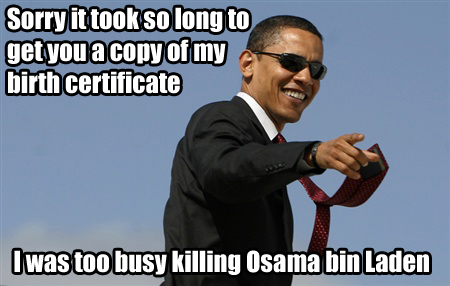
Okay, I said I didn’t want to get into domestic politics, but I ain’t pure; couldn’t pass this up:

(Credit: Andrew Sullivan, The Daily Dish)


Osama bin Laden is dead; and. . . ?

2 05 2011

A few thoughts on the death of a murderous fanatic:

1. I am opposed to the death penalty, in every case. Thus, as I noted in a comment at TNC’s joint, I may be parsing matters to consider bin Laden not the subject of a criminal trial, but a casualty of war.

2. I don’t like facile comparisons of bin Laden to Hitler or Al Qaeda to the Nazis; whatever the totalitarian similarities, the differences, I think, are are even greater.

Nonetheless, this quote from Hannah Arendt’s Eichmann in Jerusalem came to mind:

[J]ust as you supported and carried out a policy of not wanting to share the earth with the Jewish people and the people of a number of other nations—as though you and your superiors had any right to determine who should and who should not inhabit the world—we find that no one, that is, no member of the human race, can be expected to want to share the earth with you. This is the reason, and the only reason, you must hang. [emph. added]

To want to cleanse the world of its inhabitants makes you an enemy of the world and its inhabitants and gives us license to treat you as such.

I don’t celebrate his death—“grim satisfaction” seems the appropriate cliche—but I do think a kind of rough justice was done.

3. There are concerns that this action will give the US cover to leave Afghanistan sooner rather than later. Would that this would be so.

4. The death of bin Laden matters. I say this not as an expert on terrorism but more generally as a political scientists: Even if the death were only symbolic—his operational role was said to have diminished greatly in the past few years—the symbolism still matters. In both war and politics, symbolism matters.

As to whether this will lead to a retrenchment or fracturing of Al Qaeda, well, either is a possibility. Bin Laden was apparently a charismatic figure, and his former number two (now presumptive leader) Ayman Al-Zawahri is not; that could matter in terms of holding together a far-flung criminal operation.

Or not: The cell structure of Al Qaeda may mean that those freelancers gathered under the Al Qaeda banner have long since left the base of The Base behind.

We’ll find out.

5. Some are concerned at what happens next.

As a general matter, I’m not concerned; something always happens next.

As for specifics,  I (somewhat surprisingly) again agree with Jeffrey Goldberg:

Television-based analysts are already asking if the killing of Bin Laden will provoke revenge attacks by al Qaeda. Is there a stupider question in the world? The implication, of course, is that now, al Qaeda will truly be pissed off at the U.S. Unlike in 2001, when al Qaeda was only marginally angry at the U.S.

He backs off that somewhat in later posts—yes, some terrorists may be moved to strike out in rage or grief—but as Al Qaeda was not much a political organization, that is, it was not an organization with which one could negotiate, any acts around it or in reference to it or against it would lead to a reaction.

That there are reactions does not mean there should be no actions.

6. There are domestic political implications of all this, but it seems small, today, to consider them.

7. To circle back around to the Arendt quote: Yes, I think she got it right.

There are a lot of reconsiderations of her work in light of a new book on Eichmann (The Eichmann Trial, by Deborah Lipstadt), but I don’t know that any of the old or new criticisms can erode the acuity of that judgment, which deserves repeating:

[J]ust as you supported and carried out a policy of not wanting to share the earth with the Jewish people and the people of a number of other nations. . . we find that no one, that is, no member of the human race, can be expected to want to share the earth with you.