I could have been your woman of the road

12 08 2019

Allrighty, then: dmf asked in the comments if I differentiate between naming and defining. Good question! I don’t know!

I mean, I think I do: although the concepts are clearly linked, naming seems to be more about marking out the boundary lines and defining, filling in those lines? With the proviso that the filling can affect the lines? . . . maybe? To really make the case would require greater philosophical and linguistic chops than I possess; in any case, as I’m interested in the political dynamics of naming, I think I can fudge on this.

But I can’t ignore it completely. If I say, for example, that I am a woman (which I do, and I am), then I’m making a claim to at least of the qualities of “woman,” as well as claiming that some qualities that others might say are necessary, are not.

To bring this home: I am neither a wife nor a mother. I’ve been ambivalent about ever becoming the former, and pretty consistently set against the latter, but never have I felt that I am less of woman for lacking these qualities.

Why do I say I’m a woman? It’s a grab-bag: my body and its functions, my recognition of a continuity of female identity from childhood to adulthood, my willingness to answer to being called a girl, then a woman, my understanding that others view me as a woman, my irritation when others don’t recognize me as a woman, my clear sense that I am not a man, my insistence that my woman-ness makes me no less human.

There’s nothing particularly elegant in that identification: Some of the pieces are mostly relational and others, funneled through social categories; some are positive (I am this) and others, negative, (I am not that). I don’t say much about personality or temperament or affective attributes, mostly because I’m considering the social-political aspects, but, sure, there probably are additional qualities of my woman-ness which are psychological.

And I should point out something else: While I was a tomboy as a kid and have tended toward the androgynous as an adult, I’ve never questioned that I was a girl or a woman.

Okay, two something elses: The original is that I’ve had some difficulty coming to terms with what it means to be an adult. On the one hand, this is easy: I have more than enough years to qualify as an adult. I have jobs, I take on many of the usual tasks of adulthood, and, yeah, I more-or-less look my age, i.e., I and others recognize me as an adult.

On the other hand, I’m physically small, I live like a grad student, and those nonessential markers of womanhood? I’m neither wifed nor mothered, which are among the (nonessential, but pretty damned clear) markers of adulthood. I don’t own a home or a car and my work-life is cobbled-together, with only semi-regular hours. I still don’t know who I am.

The second else? Eh, I’ll save that for another post.

I’m straying from the original point—if there even was one—but I’m noting that while I am firm in my claim on womanhood, I’m kinda pro forma in claiming adulthood. I put myself inside of those lines, because, yeah, sure, I’m an adult, but I’m not sure I fill out the category all that well.

I don’t know how or that this helps me figure out political identity or political adversaries, but it might. Maybe there’s something about what is firm and what is uncertain, what I send out and what I protect, that will give me some sense of what others advance and defend.

Or maybe not. I claim no clear lines for any of this.



Everything! Everything! Everything! Everything!

8 08 2019

I something is everything then it’s also nothing.

This is a problem when trying to sort out something basic: it’s basic because it’s a part of so much, and because it’s basic, it’s easy to find evidence of it everywhere.

Thus with naming-power: it’s basic, and it’s everywhere—which means it’s hard to get my analytical mitts around it.

I guess I could get into a discussion of the different dimensions and levels of power—hell, I once taught an entire course on this—but given that I see naming as a manifestation of power, that whole thing would just collapse in on itself.

(As an aside: it’s pretty clear I think of power as some kind of manifestation or expression, that is, that it exists in relation to or through something else; on its own, well, I guess it doesn’t exist, does it? Power has no being, no ontology; it is not a thing-in-itself. Okay.)

Anyway, one way to find naming-power’s edges is to put it in a particular context. Since I am—surprise!—interested in the cultural and political aspects, specifically, in the sharpening of the concept of “identity”, then that’s my mud-pit.

~~~

You can get some sense of how I learn to sort things: I have an idea, I run it out a few paces, see if it holds up, then decide to stretch it further. Of course, in the stretching I see the thin spots and irregularities and tears and Oh, look at this line, let’s see where it goes. . . .

And then at some point I stop and go, Wait, what was the question? And I have to retrace my steps or maybe I just find another way back and sometimes the point is still there and sometimes it’s. . . not.

That’s fine. I mean, that can be frustrating as all hell, but how can I know if an idea can fly unless I toss it out there?

(Oh, and welcome to the mixed-up metaphors of Ms. Messypants NewYorker. Whatever. It’s late.)

So that’s what I do: I fling ideas hither and yon and see which ones hold up enough to stitch into a thought-line, and, maybe, just maybe, to make some sense.


I’m afraid of the words

5 08 2019

So, there are a couple of different types of naming-power.

There’s the power to determine what it is to be a part of a group. This is so common a form of naming that we often don’t call it as such; instead, we call it ‘defining’ and defenses of such definitions, ‘boundary policing’.

Examples: Who is American? Who’s Christian or Muslim? Who’s a Democrat or Republican? Conservative, liberal, leftist, etc. Such defining is a basic part of any society, and any politics, and, really, any commentary on society or politics. We seek to make sense of a jumble, and so sort things into “this” (and “not-this”) and “that” (and “not-that”) and “the other thing.”

This matters in politics, not the least in determining whether something counts as political as all, and conflicts over such definitions can lead to great anger and, in the worst cases, violence. Who’s in and who’s out and who gets to decide is a foundational set of political questions.

There’s also the power to name oneself: I am this, and this, and this, and not that, or the other thing. This self-naming can set eyelids to twitching; asking or reminding or demanding that others recognize one as this, and this, and this can, yep, set others off.

Coupled with this is the shrugging off of what others have named you: You have said I am this, but, no, I am not-this. Not only are you claiming the power to name yourself, you are denying the power of others to name you. Ditto on the off-settings.

Now, what can also happen in the process of claiming a name for oneself is the unearthing of the history of names, and how what was assumed, should not be.

This last bit sounds abstract, but it’s not: Consider how “the race question” in the US was so often about [white people discussing and defining] black people. Then black people said, loud enough for white people to hear, No, we’ll define ourselves, thank you very much. Oh, and by the way, we have a thing or two to say about white people. And over time something known as “Critical race studies” emerged, and race was jostled out of its convenient eternal meanings and historicized, with one result that whiteness was no longer a timeless standard, but just another historical artifact.

This is an utterly incomplete and not-accurate account of the evolution of the study of race in the US, but you get the point, yes? Whiteness had been claimed as the default, worthy only of defense and otherwise off-limits to the commentary of those who were deemed not-white. To take whiteness out of the assumed and into the studied is to destabilize it. It’s not that whiteness has no power—christ, no—but that it is contingent means that it is not, strictly speaking, necessary.

~~~

I don’t quite know where I’m going with this, and I definitely want to hit on gender-identity issues, but this is enough for tonight.

~~~

Oh, and you absolutely should listen to this.


That’s not my name

2 08 2019

In the beginning was the Word, and the Word was with God, and the Word was God.

1 John 1:1

The power to name is one of the most elemental powers: to name is to identity, and to identify is to place.

If I name you as X, I’m identifying you as belonging to a particular kind, a particular history, as having a particular potential, a particular worth.

I’m claiming a knowledge of you and over you; even if I’m not conscious of the power of the claim, the power remains, nonetheless.

This sounds portentous—I certainly write as if it is—and it can be: anyone who’s ever been the target of slur knows the sting of bad naming. But it can also be affectionate, silly, a form of play; it can divide, bind, clarify, obscure, demean, liberate, and on and on.

Any power worth its salt is a trickster.

~~~

All of this is a preamble; now let’s see if I follow up.


You gotta know when to hold ’em, know when to fold ’em

24 07 2019

I would give five bucks to the candidate who’s willing to say: “Hell, yeah, I’m a politician—and a damned good one!”

I know, I know, we’re all supposed to hate politicians and love the mavericks and outsiders and ‘jes plain folks’ who’ll stand up to the corrupt and immoral insiders.

Blah blah blah.

This is of the same piece as “those who can’t do, teach”, which, yeah, as someone who teaches, I find irksome. But more than the personal jibe at such a non-doer as myself, I’m irked at the falseness of the statement: teaching is doing, and it’s hard.

I work at it—the syllabus, the readings, the assignments, the lectures and discussions, all of it—and some days I’m great and some days I’m not; overall I’d give myself a B+. I wouldn’t mind taking a class from someone like me, but, honestly, I’d also want professors who were better than me.

And you, the dumb-ass who thinks teaching is nothing? You know nothing.

You see where I’m going with this, right? Being an effective politician is hard. Politics is a (sometimes glorious, sometimes fetid) mess, and being able to balance all of the competing concerns and different interests and principles and practicalities and rules and ratfuckers and flying monkeys to get anything done requires more skills than are dreamt of in such casual dismissal of the role.

So I want to vote for someone who embraces that role, who gets that just because anyone can run for the job—which is great thing, really—doesn’t mean that anyone can do the job. And to do the job well? You gotta learn, get better, become a pro—become a politician.

That’s a good thing, and should be recognized as such.

Not gonna happen, tho’, I know.


You see, got my brother down cause it’s nothing to me

16 07 2019

I have nothing to say about the racist bag of maggots currently befouling the White House—nothing beyond curses and sputtering, that is.

He’s a terrible man and a terrible president with terrible policies enabling the worst of us. And that he has a good shot at re-upping his tenure is really more than I can handle right now.

I don’t follow any pro-Trumpers on Twitter—Twitter is my junk food, and I prefer my snacks in salty left-wing, artistic, academic, or animal form—but I do run across them online, and, honestly, . . . huh.

The outright racists who love him, okay, that makes sense. While I only understand racism on an intellectual level—I don’t get on the gut-level why anyone would want to be supremacist—I can identify it as an interest that the maggoty misogynist meets. And the cynics, like Mitch McConnell, who’ll excuse anything to get what they want (tax cuts, 19th-century judges): again, the interests intersect.

But the people who consider themselves principled, moral, who support him? Are they just lying to themselves about their morality? Are they in denial about the awfulness of The Donald?

There’s a fair amount of anger I hear from them, and fear about coming breakdown/SJW totalitarian takeover, and it’s not hard to read that anger-fear as its own justification. It’s also a handy way to deflect responsibility from one’s own actions: Look what you made me do!

That doesn’t seem enough, though, to explain how we could look at the same Tweets or hear the same speech or at fucking children in cages and reach such radically different conclusions about them. It’s ideological, yeah, but that’s hardly a sufficient explanation.

This might be where political psychology comes in, which is extremely not my bag. I don’t have anything against it in general, but it’s always seemed to me that the ‘political’ piece loses out to the ‘psychological’; since I want to understand political phenomenon as political, I’ve been leery of anything (incl economics or orthodox Marxism) which reduces the political to mere epiphenomenon.

Still, since I take politics as necessarily a scavenger field, dragging in economics and culture and religion and passion and psychology, etc, perhaps I simply need to get to diggin’ in other areas of this messy yard. I might never get it, but at least I’d have a better sense of the disconnect itself.


Hot summer streets and the pavements are burning

14 07 2019

I am a dope.

I hate hot weather, hate being sticky, own an air conditioner, muscled that air conditioner into a window a week or so ago, and. . . I don’t use it.

I hate being hot and sticky and have a way to be neither and I don’t take it.

Right now I’m sitting in my chair with a fan propped in a window and angled toward me. Still, I’ve got my shirt half rolled up and if I move a body part even a smidge out of the blowing air it will start to sweat.

It’s not that bad out, actually: temps should fall below 70 overnight and it’s not humid, so sleep (with, again, the fan angled toward me in bed) should be fine. It’s just that it takes awhile longer for the cool of the outside to push aside the day’s accumulated heat.

And tomorrow, tomorrow shouldn’t be bad, either. Tuesday will suck, and Wednesday, even more so; my line for turning on the a/c is over 90 and humid during the day, over 75 and humid at night, and it looks like that line might be breached.

And yet odds are even that I’ll rely on my fan to wave around hot air rather than shut the windows and let the a/c clear out all concerns about the weather.

So, yeah, I’m a dope.


Mexican kids are shootin’ fireworks below

4 07 2019

We shamble on. . .

But since we also have kids in cages and adults bundled like fasces behind walls:

There’s much to like about this country, much to celebrate, but if you’re not also angry and ashamed, then I wonder about the nature of your celebration.

As for the rest of us: let us take what is good and use it like a lever to overturn what is not.


Come put out your eyes

2 07 2019

University websites are of the devil.

One of my on-again off-again jobs requires me to find information on college and university websites (those offering associates and up only), which means that over the years I’ve probably looked at every single one of those websites (3000+) at least once, and a fair number, two or three times.

It sucks dirt.

Community colleges tend to be less awful, i.e., more straightforward. Maybe they have less money to throw at “innovative” designs, or maybe the people in charge of the website have less patience for bullshit, or maybe the would-be students of those institutions have somehow convinced the site designers to just give out the information already.

Elite schools, arts schools, and small liberal-arts “name” schools are often the worst offenders. Oh, here’s a website that will open with a series of scrolling images and rah-rah pull-quotes and advertising copy. Maybe there will be links to Degrees and Admissions and whatnot in a taskbar, maybe those links pop out at the menu icon, but once you click on the desired link, you are welcomed to a whole new set of scrolling images and rah-rah pull-quotes and advertising copy.

Oh, and blog posts, because of course you, a prospective student, want to read what’s happenin’! at Admissions.

You think I’m exaggerating? I am not. Consider Johns Hopkins University. Go ahead, click on the link.

Now tell me, how long does it take you to find what are the requirements for admission as an undergrad?

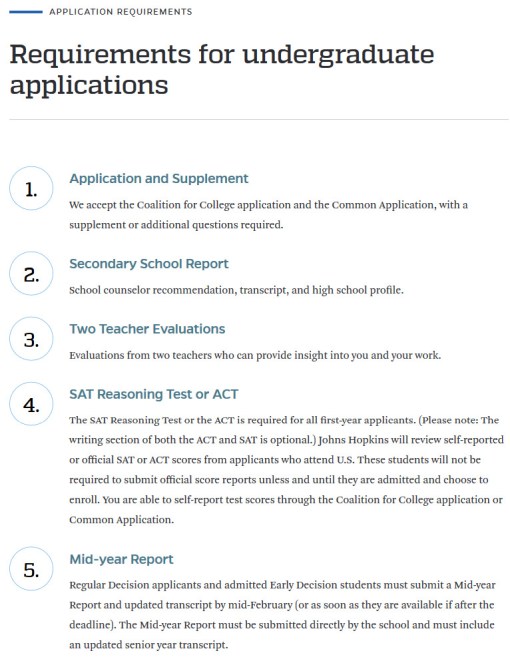
You can find the link either at the icon or on the bottom, which then takes you to a page which requires you to click either undergrad (with a separate link to the Peabody Institute—good luck if you don’t already know that that’s the place for performing arts) or grad, then, when you click on undergrad, you get this:

You think, Huh, I might want to apply, so let’s hit “Application Process”, then scroll down a bit to find this:

Nifty, you think. Now, what are the GPA requirements? What scores do I need for the SAT and ACT? Oh, look there’s a link to “Deadlines and requirements”:

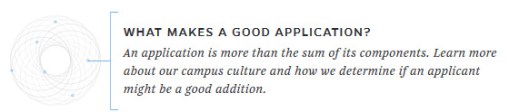
Huh. A list of deadlines. . . wait, here’s this illustration-quote-thing:

Excellent! Just what I want. . . oh, this is just an image, I can’t click on it for more information.

Well, there is at least a link to “Standardized Test Information”, which, hmm, tells me how to submit my scores, what JHU will do with them, how they’ll calculate repeat test submissions—which is useful, yeah, but since I don’t know what the cut-offs are, how do I know whether or not to retake?

Huh.

Okay, I see, there’s an FAQ link up near the top: that oughta tell me something, yes?

No.

All rightly, then, let’s just click on every damned link on the Admissions page. Nope. Nope. Nope. Nope. Nope. Nope. Nope.

Ah, here’s something useful, via Discover JHU/Get the Facts: a snapshot of the Class of 2022, which includes “middle 50th percentile” SAT & ACT scores. Okay! If I’m above those numbers, I should be good, right? And maybe take again if I’m way under. . . ? What about slightly under?

I can at least find out how much everything (tuition, housing, etc) costs: just a hair under 75 grand for on-campus students, about 70Gs for off-campus.

Well, then.

I pick on Johns Hopkins because a) I had to try to find information on their website today and am thus still irritated, many hours later; and b) for a non-artsy school, it’s one of the worst.

I have nothing against Johns Hopkins as a university—it’s a very good school—but if I were some first-generation-college kid from podunk Wisconsin trying to figure out whether I should take a shot at applying to it? Fuh-getit.

That might be the point—they only want students who don’t actually need to use the website for information—but I doubt it. I think the site was designed by people who think, Ooh, this’ll look good on a phone or tablet or whatever, who like how clever/inspirational/creative it all is, but who haven’t a clue how people who haven’t a clue how universities work might actually want to use their site.

Now, it’s possible that this does work for some subset of students, and that admissions counselors are available to fill in all of the blanks, but, man, it is also possible that this joint would intimidate someone into not even bothering to contact that counselor.

(I know, in fairness I should do my alma mater. I have no faith that it will actually be good, but, sheesh, it can’t be worse than JHU.)

Having done this job, I know too much how colleges and universities are organized to have a good sense of how an undergraduate might navigate the site for information—do they know that the bulk of undergrad programs would be in a college of arts & sciences or liberal arts? do they understand general education or core requirements?—but I wouldn’t be surprised if they’re almost as useless for current as for prospective students.

And faculty? Staff? Ha, right.

So, I gotta ask: if these sites are garbage for prospective and current students, for faculty and staff, then just who in the hell are they for?


And Sir Sun stands up

20 06 2019

Fucking summer.

It’s been a cool June so far in NYC, but you know that by July the weather will be filthy and by August, murderous.

So, in “honor” of the worst of the four seasons, some sun and summer songs.

From back in me college days:

This got a lot of play when I was living in the apartment on Breese Terrace (right across from Camp Randall stadium). I don’t know that I yet hated summer—I was probably still operating under the delusion of fellow northerners that one should be glad that summer’s here, as it least it’s not winter—but regardless, I liked this one. Still do.

This one’s a throwback to the seventies:

I didn’t have this album—this came out before my album-buying days—but my older sister had a copy of Captain Fantastic and the Brown Dirt Cowboy that I listened to, up in our shared bedroom, so I tend to associate all songs of this era with the seventies, even if I didn’t actually listen to them back then.

As to that first album I bought? Foreigner, Double Vision. I was mad for Foreigner, and at twelve or thirteen, when I started really paying attention to music, this. . . this is what I wanted.

I still listen to old Elton John. Foreigner? Not so much.

I fuckin’ love this song, still:

In fact, I hopped out of my chair and lip-synced to this as it played on my tinny computer speakers.

This would make a great song for a chorus, don’t you think? So many ways to take this.

Man, I fuckin’ loved all of early U2, and while I don’t hate them now, at some point getting their new music was no longer necessary. But this song reminds me of when it was.

This is kind of a trash song, but I do love me some Be Good Tanyas:

A friend of mine who, well, kinda of worked music festivals (as in, he had a job that mostly had nothing to do with music but sometimes did), once booked the Be Good Tanyas. They fought like hell offstage, he told me.

But the show was fine.

This one was included on a mixtape sent to me in grad school by my friend L:

I don’t know this artist well, or, really, at all, but apparently Eddie Vedder later covered the song.

Anyway, I listened to this song on my walkman on the number 2 bus taking me down Franklin, heading toward and away home.

And, of course, this is the song that’s counts as hopeful for mopes like me:

God, what a great song.

The Police was one of those bands I was introduced to by MTV. I don’t know what anyone thinks about MTV these days, but back in the ’80s they played all kinds of shit I couldn’t get on the radio.

Falls is between Green Bay and Milwaukee, so I’d listen to stations out of there (mostly Milwaukee, honestly, 93.9 (?) WQXR! and a station at 97-point-something), the relevant ones of which were either Top-40 (which I, a cool teenager, disdained) and hard rock. I was into the latter in my early teens, but once I heard post-punk and New Wave, it was all over.

Anyway, the Milwaukee School of Engineering was rumored to have a great indie station, but the signal was weak and we almost never got it up in Sheb county.

So MTV was it. It was terribly white, back in those days, which I might have tutted about, but honestly, I dug the Police and the Eurythmics and the B-52’s and the Femmes and BoDeans and on and on, so Music TeleVision fed me what I needed.

There are many, many, many, MANY more summer/sun songs, but here’s one on how to deal with the heat:

Naked is a state of mind, indeed.