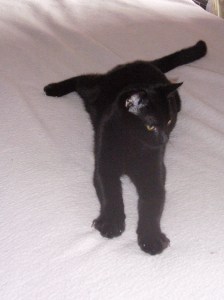
Fly into the sun

18 11 2009

Could you tell my post last night was dashed off?

I was thinking Oh, man, I gotta post something. What? What? Then I did the dishes, which apparently put me in mind of the apocalypse.

As I told C. in the comments (who corrected an author error in the post: Clarke, not Huxley, wrote Childhood’s End), I was so lazy I couldn’t be bothered to tab over and look up various movie titles on IMDB.

Pitiful.

Thus, an elaboration on yesterday’s post, as well as an important qualifier.

The elaboration

C. astutely noted that I included dystopias with my apocalypses. So true. I guess  I tend to think that any dystopia worth its salt was preceded by some kind of apocalypse, but they really ought to be separated.

Had I been engaging anything other than minimal brain power last night, I would have figured this out in my (minor) deliberations over whether to include Brave New World. I did not, because, as I noted in the comments, the shift into Fordism seemed a kind of progression, rather than break, with what came before.

My list was also quite sloppy: I Am Legend popped into my head, then popped right back out. (I saw the Charleton Heston version, and parts of the Will Smith. In either case, definitely apocalyptic.) And I couldn’t remember the name of that damned book with the conch and boys and Piggy, and so left it off. (Golding’s Lord of the Flies. I thought there was mention of an a-bomb at the end, but it’s at the beginning.)

There’s another book, too, listed at the back of the paperback edition of The Gone-Away World: Kevin Brockmeier’s The Brief History of the Dead. It veers between an occasional (and thoroughly enjoyable) nasty humor and genuine pathos. More light than heavy.

I’d count Neil Gaiman’s American Gods, too, if only because of the threat. But I didn’t include Max Barry’s Jennifer Government because, if I remember correctly, that society arose more like Huxley’s Fordist scheme than through anything apocalyptic.

And I missed the whole field of Christian apocalypse, a.k.a. the Rapture. Now, there is a very good movie called The Rapture (David Duchovny, Mimi Rogers), but that’s a Hollywood film, as opposed to a Soon-To-Be-Coming-To-An-Earth-Near-You True Believer flick. I used to be a regular imbiber of TBN and CBN (wacky evangelistic fare), and they’d regularly show rapture films. Don’t know the name of a single one.

I do know, however, The Omega Code (produced by TBN and starring Kirk Cameron), which is  basic Bible-code Armageddon. And, of course, Jenkins & LaHaye’s Left Behind series. I tried to read it, but couldn’t get through even book one. I have a high tolerance for this stuff, so you know it’s bad. (But if they make a movie of it—have they made a movie of it?—I am so there.)

There are likely many, many more of this subgenre that I’m missing.

I also overlooked the Mad Max movies. I liked the second one, Road Warrior, best, but the first and third aren’t bad. And I have the sense that those crazy Danes probably have a bunch of apocalypses hidden in their Danish libraries. (Don’t know why I have this sense; just do.)

Well, I’m counting on C. to come up with a proper doom list.

Now, the qualifier.

None of these books or movies are based on historical events. Some of these may speculate on a future which could become history (got that?), but in no case are these movies or books based on anything which has actually happened.

No Holocaust. No Hiroshima or Nagasaki. No Native American genocide. No historical genocides, period. No plague, flu, smallpox, etc. No Mt. St. Helen’s or Vesuvius or Tambora or any actual natural disaster. No Chernobyl.

No event in which actual human beings experienced their own version of the apocalypse.

I don’t put these events off-limits, not by any means. A good book or movie is a good book or movie, and I think all of the stuff of our lives and deaths is there for the taking.

But I don’t include these in my apocalypse list.

There is a glee in thinking of how the world might end, how humans might respond—wondering how I would respond—to total disaster, precisely because it is so speculative. Look at all the possibilities of our end!

Possibilities. Not certainties.

In historical ends, there is a certainty, the most significant of which is the certainty of actual human suffering and death.

Again, a worthy topic of fiction. But not of glee.



Burn baby burn

18 11 2009

I fucking LOVE apocalyptic movies!

Death! Disaster! Mayhem! Whoo hoo!

And if they’re religiously themed? Even better.

Now, I define apocalyptic broadly, to encompass existential ends, partial ends (of countries, cities) as well as the mere possibility of world’s end.

Oo, world’s end—let’s see, Childhood’s End, an Aldous Huxley (Arthur C. Clarke—h/t C.) novel about—yep—the end of the world. Read that one (the, uh, first time) in high school.

So let’s extend the love for all things apocalyptic to novels, as well.

It should go without saying that these movies/novels are often awful. Children of Men was a very good movie (and so-so novel), but that, I think, was an exception.

Terminator 2 was pretty good, but really, really, really long.

Terminator? Okay.

Terminator 3? Okay. (I missed Linda Hamilton.)

Terminator 4? Umm, is that on Hulu? Maybe if I ever sign up for Netflix. . . .

Goofy apocalyptic is good, like Independence Day. Or what was that movie with Tommy Lee Jones and Anne Heche about the volcano in Los Angeles? Goofy is what it was!

And certainly better than the Pierce Brosnan volcano flick—which, while it had Linda Hamilton, did not have Sarah Connor.

So, too, with Deep Impact Armageddon (Bruce Willis/Ben Affleck comet movie) and the Morgan Freeman/Tea Leoni comet movie (Deep Impact). You’d think the Freeman/Leoni duo would kick Willis & Affleck’s asses, but, no: Deep Impact Armageddon wins by goofiness.

Prophecy, with Virginia Madsen and Christopher Walken—really, you have to ask? Christopher Walken! And bonus with angels and Satan and stuff!

Much better than End of Days, with Arnold Schwarzenegger. Too stodgy.

The Ninth Gate? Not really world-ending, but really fucking weird. And Satan and stuff.

Stigmata? Not really at all, but it had visions and angels and stuff. And Gabriel Byrne.

Waterworld? Nuh. Kevin Costner, not in his lovable-crank personna (Bull Durham, Tin Cup), but just annoying crank. But Dennis Hopper was fun.

Day After Tomorrow? Please. (And while I’m certainly willing to watch bad bad-end movies, I’m not willing to pay 12 bucks to do so: 2012 will have to wait.)

War of the Worlds? I have the Tom Cruise version stamped on my brain. Too muted. And Tom Cruise. . . .

Oh, and On the Beach. Odd, but great. The first half is a bit of a caper flick, with Fred Astair and Ava Gardner (man!) and stiff-and-honorable Gregory Peck, but still (SPOILER), no relief: everybody dies.

The Day After played on t.v. in the 1980s, to much hue and cry. I saw it again a year or two ago, and while it was mighty cheesy, still.

Testament was not cheesy. I still (mis?)remember the scene in which Jane Alexander is sitting in next to sun-filled window, sewing, her face determined. It’s only in the voiceover do we learn that this is a shroud for her daughter.

28 Days Later gave me nightmares for a week—then terrified me out of sleep six months later.

Didn’t see 28 Months Later, however—tho’ if it streams on Netflix (if I ever. . .) then, maybe.

I should catch up with all the old George Romero flixs. While I’m not a big horror fan, zombies work.

World War Z, by Max Brooks. Have you read it? A fine bit of reportage. Sparked an unfinished bit of writing from me, on the ethics of zombie-killing and -experimentation.

Margaret Atwood has written a number of apocalyptic novels, although these tend toward collapse-apocalypse as opposed to war/violence-apocalypse. Oryx & Crake was hilarious and cold—just right; her new book elaborates on the O&C theme and is, according to a number of critics, better than the original. Hmpf.

And then, of course, The Handmaid’s Tale—I’m currently using that in one of my pol sci classes. When I polled the class on when/whether they would try to escape the totalitarian Republic of Gilead, most of them were of the I’d-wait-it-out variety. Really? I all-but-yelped. Only one student was with me: as soon as we lost our jobs or our money, if not sooner, we’d be gone.

Turn me into an Unwoman—no suh!

Gone-Away World, by Nick Harkaway. What? You still haven’t read it? Honestly, what’s your excuse?

There’s more, of course. Fahrenheit 451. Don DeLillo. The Plot Against America. Walker Percy. Peter Hoeg. Jose Saramago. 1984. A couple of Marge Piercy’s. A couple of Mary Doria Russell’s. William Gibson.

Science fiction? Speculative fiction? Whatever. If the earth is in peril/ends, it’s in.

C. was going to start an apocalyptic book club at the bookstore, but a necessary manager bailed. Still, I’d expect that she’d have even more to offer.

And, again, quality is not really the point, here. Even the books or movies I slagged I’d still (re)read or watch (again).

The point is that they are 1) fiction; 2) fun! and/or terrifying!; and 3) the world ends!

Should I mention that a number of us have made plans to see The Road Christmas night?

The director had better not make it ‘inspiring’. . . .


So when they ask me later, I won’t tell them how it’s going

8 11 2009

So much to do, so little inclination to follow through.

Grading. A kajillion papers. Or 70. Somewhere in there.

The papers aren’t long. If I start grading now, do some tomorrow night, then Tuesday and Wednesday, I’ll be fine.

Or I could just wait until Wednesday—night—and stay up too late and get too little sleep and plow through and end up kicking myself for being such a procrastinating idiot.

Hmmmm, wonder what I’ll do.

Then again, I punted on dealing with the whole credit thing, but  that’s taken finally been taken care of. For now. And If I get a real job, there’ll be no worries at all.

Of course, there are all these worries over getting a real job.

And I’m doing all I can to get a real job—ja, you betcha. Sure.

That’s on the list, eh? And we all know how well that whole list thing is going, right-o? Sure.

If only I were motivated by free-floating anxiety.


What shall we use to fill the empty spaces?

3 11 2009

Things will be different this winter.

Hard.

Not the weather—sleeping. Without Chelsea.

You see, Chelsea was incredibly fucking annoying to sleep with once the weather turned cold.

She’d jump up on the bed (not annoying), walk over my body or head (slightly annoying), then sit near my shoulder (not annoying).

Waiting.

Waiting for me to lift the covers that she perfectly well could have burrowed under herself—but no, Herself had wait for me to lift the covers.

If I didn’t immediately do so upon her arrival near my shoulder, she’d make a few pigeon noises (low coos), then again, at a slightly higher volume.

Still nothing? She’d paw at the blankets, lightly at first, then with some vigor.

Still nothing? The paw to the nose. And if still no reaction, she’d push out her claws ever so slightly and softly—no scratches, no marks—rake them across my cheek and nose.

At which point I’d lift my arm and create a proper entrance for La Chelsea.

This is not the really fucking annoying part.  No, what was r.f.a. was her pause.

Yes, after all that, she’d take a step, then pause for a few seconds, as if wondering Hm, do I really want to go under the covers after all? before deigning to duck down and under.

Jesus, she had me so well trained.

Then, of course, she’d turn around and around and around before settling into the same damned spot she always did, curled into my belly as I lay on my side, wrapping herself into a warm ball of purr.

That, I admit, was never annoying.


All alone in the moonlight

1 11 2009

I take back everything I said.

Well, not everything.

And I don’t really take it back.

Let me, shall we say, add to what I wrote in the last post.

Memory matters to me. I don’t want to get ensnared in it, but I don’t want to forget, either.

I don’t want to live in those memories, don’t want to act as if that’s where my life really is or belongs. I’m not about to head off to my first day of first grade.

But that was once me. I did once wear dresses my mom made, wear ponytails (which I preferred to pigtails, i.e., knots worn high above the ears) and barrettes, and smile into the sun and for the camera.

Today I only occasionally wear my hair in a single ponytail, only occasionally smile into the sun, and rarely for the camera.

This isn’t a paean to lost innocence. I was six then and am some decades past six now. I grew up, and am glad for that.

I lost a lot along the way, as does every person who makes the trek from child- into adulthood, and have gained, as well. Again, nothing unusual about that.

And I guess that’s what I do need to remember, that there is nothing unusual about this—that I do have a past in addition to a present and likely a future. This is what it is to be a modern adult.

But I also have to remember that I have as much and as little control over that past as I do my future. I can’t always call up memories at will, can’t always place them when they do surface, and don’t always know what to do with them. Good, bad, happy, sad, indifferent—doesn’t matter. They’re there and they’re gone and they sometimes come back.

And in coming and going they carry pieces of me with them.

I live here, now, but I don’t yet understand what it is to live here, now, and to move into my future. No, I don’t want, per my last post, to get stuck in a cul-de-sac of my past, but I can’t and don’t want to erase it, either.

Not anymore, at least: I have tried, and failed, to erase it. If you don’t think you belong in life, it’s only a hop to the belief that you need to erase all evidence of your self, if only in yourself.

But now I’m re-constructing my life, re-claiming it. I have no idea what I’m doing, not sure of these pieces which come both bidden and not so, not sure of my. . . hopes? possibilities? for the future.

(And, oh yes, I can carried away by the future, as well; what finer form of escapism than to think But later, after. . . ?)

Neither my past nor my future is under as much control as my present, and even my present is under less control than I would like (tho’ I do admit that that’s not wholly a bad thing).

Still, I am here, now, which means making what sense I can of who I was, then.

Or at least recognizing that I was, then.


Don’t look back

31 10 2009

Getting rid of my t.v. has not much altered my viewing habits.

Hulu. And CSI on CBS. (I’m still watching CSI: NY, but that may end. They’re turning the damned show into a blue-tinted CSI: Miami. One Horatio Caine is already too many.)

I’ve watched some Buffy and Angel and (guilty pleasure) Stargate SG1, along with a few episodes of the 21st c version of Battlestar Galactica. I watched the opener of FlashForward, but none since. Oh, and Stargate Universe, which is grim and intriguing and just a little bit boring.

The Good Wife is supposed to be good, as are Glee and Community, but I don’t know that I want to get snagged into anything else. I got shit to do, and I’m already finding too many ways to avoid doing it as it is.

I was a regular viewer of CSI et. al. before I stopped watching t.v. over a year ago, so I don’t really feel like I’m making any new commitments; even the new SGU feels more like a mash-up of the old SG1 and BSG.

Only FlashForward was at all new, and I watched that because I’d heard good things about it and was intrigued by the premise. But while the kickoff was mildly interesting, a part of me was thinking Do I really want to let myself get sucked back in? I was relieved to read that later episodes sucked.

Of the shows I watch, only two are still on the air (SGU & CSI); Buffy is disappearing from Hulu and I’m almost done with SG1.

So, no truly new shows, and a few old ones of which I’ve pretty much had my (re)fill.

But what about those old old shows—you know, like Lou Grant? Didn’t I write a little mash post to Lou Grant a month or so ago?

Haven’t watched it since.

I noticed today that the classic version of Bionic Woman is on Hulu—it shouldn’t surprise you that I loved that show as a kid—as are other shows I watched in my parents’ house. One Day at a Time. Partridge Family. Charlie’s Angels. Picket Fences. Hill St. Blues. St. Elswhere. Hell, a bunch of shows from my childhood and adolescence are on Hulu; I could spend any number of weekends gettin’ my nostalgia on.

Except. Except I don’t really want to.

It’s not that I wouldn’t enjoy the shows again—I have no idea if I would—but that I don’t want to go back. I went through that time once, watched those shows then.

Enough.

It might seem like I’m making too large a point about too small a matter—old t.v. shows—but I really don’t trust myself to look backward. It’s not about the time being good or bad; it’s about it being over.

Yes, I do look back, and am sometimes pulled back, but I always have to keep in mind that I live here, now. A little escapism is fine, as is a considered reflection on memory, but not too much, and preferably only if it helps me make sense of my life here, now.

I’m already sufficiently disoriented by my presence in the present. I don’t need to add to my distractions.


God don’t like it

28 10 2009

Posted by Hemant Mehta  October 21st, 2009 at Friendly Atheist

(h/t: Goldblog —who usually pisses me off, but this is funny)

Now, if only there were a religion based on frozen Oreos, black coffee, sleeping in, psychopathic kittens, and deep fried cheese.

And gin, of course. Gin. (With generous dispensations for the substitution of any old-school liquor.)

That shouldn’t be too hard, should it?


God sometimes you just don’t come through

27 10 2009

Goddammit. Time to write the goddamned God post.

Bad way to start? Too. . . insulting? Too glib-without-being-funny?

Look: Two lines in and already I’ve succumbed to the meta!

Okay. Let this post be born again. . . . All right, all right, I’ll stop.

Long discussion over at TNC’s joint on atheism and belief and who’s better and worse and why [not] believe, et cetera. As Emmylou sang, Yet another battle in the losing fight/Out along the great divide, tonight.

Ta-Nahisi Coates writes a great blog, and he attracts great commentators, but this thread follows the usual  progression:

  • God kills!
  • No He doesn’t!
  • Yes he does!
  • Well, okay, maybe, but so does Hitler/Stalin/Mao
  • It’s about ideology
  • It’s about human nature
  • It makes no sense to talk about atheists as a group
  • Then why are there atheist groups?
  • Those are activist groups. Atheism is simply a-theist, i.e., without god(s)
  • To not believe requires faith
  • ????
  • ‘Lack of belief is not a belief. True. But belief in a lack is.’
  • ????
  • Religious people are mean
  • Atheists are mean
  • Mean people suck
  • Flying Spaghetti Monster!
  • Faeries!
  • Unicorns!
  • [sigh]
  • You need to read more
  • No, you need to read more
  • You’re dumb
  • If I’m dumb, you’re super-dumb [Oh, wait, that was a couplet from The Brady Bunch, Jan to Peter]
  • Can’t we all just get along?

In other words, same as it ever was.

[Tho’ as an aside, can I vent a wee? To state that ‘is’ and ‘is-not’ are, in fact, the same, is a kind of infuriatingly useless word game. If you don’t believe in God, then you believe in a no-thing, which is itself belief, which means atheism is a form of religion. If all you’re doing is engaging a Wittgensteinian wit—for which that actual Wittgenstein would probably eviscerate you—fine; but if you think you’re making a serious point, you’re not. These arguments are not simply about the formal structure of language, but the content contained, however unsteadily, within that language. And yes, at some point, I’ll probably bore you with another post about why this distinction matters.]

Ahem.

So. I’m a-gnostic (lack knowledge), which may have a-theist (lack god) implications, but I’m not particularly dogmatic about it.

I doubt, and I’m fine with my doubt.

When I was a kid, I believed in God. I was an altar girl (the first, which somewhat discombobulated poor Father K., tho’ to his credit he brought me along) at the local Episcopal church, and, overall, I thought God was pretty cool.

Jesus was fine. I liked looking at the various crucifixes in the church, but, honestly, I thought more about God than Jesus. (I clearly lacked an understanding of the subtleties of the Trinity.)

I read a children’s bible. I wore a cross. I prayed. I mostly didn’t pay attention, but when I did, I thought it was all good.

Things changed, of course. Everyone has his or her own [de-]conversion story; mine has to the do with the rise of the Religious Right, and my disdain for any belief that could be connected in any way with the Moral Majority.

Have I ever mentioned that I started reading Ms. in the eighth grade?

Anyway, baby, bathwater: Out!

Things changed, again. I never really believed, again, but I did start to think about religion and belief, to learn more about its varieties—to pay attention.

Oh, so, so much more to this story, but let me, pace Lenin, telescope my history: I got to like hanging out in (empty) churches, a close friend and her husband became much more deeply involved in their faith (they don’t like the term ‘born again’), I read a grown-up bible, I had some good conversations with a local (NYC) Episcopal priest and. . .

. . . I still don’t believe.

Let me amend that: Some days I believe (in a non-specific way), some days I don’t, and some days the belief and unbelief is layered on top of one another.

Faith, however, I completely lack. That there may exist a God does not mean (S)He wants or has anything to do with us.

Faith seems to me far more dangerous than belief, tho’ I’m not sure why. Perhaps it seems more uncontrollable to me, or more personal, or that it is far more often deployed as a weapon than belief.

Okay, I know: stop making sense.

C. might argue that, insofar as I accept the information gleaned from scientific processes, I have faith—if only in the reliability and validity of those scientific processes. And Karl Popper (the great orthodox-science defender) admitted that one cannot use the logic of the sciences to defend the use of the logic of the sciences; at root, he noted, there is a leap.

A leap of faith? I dunno. Seems more like a jump-start to me: it’s up to the engine [science, reason] to actually move the vehicle along. If one’s methods don’t work—if they are neither verifiable nor reliable—then they are to be abandoned. Faith won’t see you through.

But religious faith, it seems to me, is itself the engine—the faith is itself the point. And while some might seek natural justifications for supernatural faith, such justifications are kind of beside the point. They might have a role, but, again, they won’t see you through.

A few weeks ago I blew out a bunch of words about Legos and coins—those of us who seek to put their lives in lock-step, and those of us who cobble bits together, precariously. As a coin-er, I’m not much troubled (there are exceptions) by gaps and inconsistencies, unknowns and uncertainties.

I can’t be, given how often my ground shifts.

Is it faith that keeps me going? Doubt? I don’t think it matters. I am no longer pained by the fact of my existence, by the justification of my self.

I just go.


Gimme the ball, gimme the ball, gimme the ball—yeah!

25 10 2009

How should you regulate an activity in which damage is inherent to that activity?

Less abstractly, if certain positions in football necessarily lead to brain damage, what should be done?

Over at TNC’s blog a number of us were chewing over the implications of Malcolm Gladwell’s recent article on dementia in football players. Gladwell compared footballing to dog-fighting—a comparison which I’m not exactly sure holds—but the info regarding the high probability of long-term brain damage even for non-NFL players is worthy of further consideration.

Some argue that risk is inherent in all kinds of activities; that doesn’t necessarily mean such activities should be regulated. It’s a reasonable enough point, but it’s not clear that such a laissez-faire attitude is the correct one for this situation.

One, the football and practices fields are workplaces, and as such, are not the same as recreational places.  How is it okay to state that football players—most of whom have careers of less than 4 years—have to suck it up while we as citizens would never tell coal-miners or uranium workers to suck up cave-ins, black lung disease, and long-term radiation damage?

They’re adults, they’re getting paid—and better than any miner is is not an excuse to overlook the dangerous conditions of the workplace itself. Yeah, the minimum wage for rookies is $193,000 (and oh, what I wouldn’t give to make a minimum of even $93K), but is it acceptable to say If we pay you enough, it’s okay to damage you to the point after which it is difficult to enjoy the rest of your life? And if so, how much is ‘enough’ to take away the rest of that person’s life?

That the NFL Player’s Association has thus far done a shitty job of taking care of its members hardly excuses the NFL—or, for that matter, the NCAA (which is a racket deserving of its own post)—for putting its players in a situation in which the only way to do the job well is to damage oneself.

Which leads to the second point: There is a distinction between activities in which risk of damage is omnipresent to those in which risk of damage is necessary. Downhill skiing, rock climbing, bicycle racing, even, as Gladwell points out, professional auto racing, are all risky activities, but to succeed in these endeavors one only risks, but does not necessitate, damage. There is risk of a wipe-out on skis or a bike or in a car, but if you wipe out you probably don’t win. Success does not depend upon damage, but upon the avoidance of damage.

Success in football, however, requires damage. Some positions are risky in the sense of ski or bike racing—punting, say, or perhaps even quarterback—but others require the players face off and smash into one another play after play after play. To be an offensive or defensive linesman is to throw your large body against another large body, to prevent anyone from getting past you or for you to try to get past the other.

That’s the whole point of these positions: to try to hold or break the line.

Football doesn’t work without linesmen. And thus far there is no way to play the game without incurring damage to these players.

So what to do?

Beyond a call for further research, I don’t know. I’m a football fan, but, for many reasons, an ambivalent one. I don’t, for example, enjoy pro boxing, not least because I see damage with every blow. I don’t see the damage to these heavily-equipped and masked men, and as much I recognize the importance of the linemen, I pay more attention to the flash players—the quarterbacks, receivers, running- and cornerbacks. Whoo-hoo! I cheer, when my team scores.

And no, it’s not the linemen who score.

So, again, what to do? Dismiss the whole thing as unworthy of concern: These guys are meatheads. . .  They know what they’re in for. . .  Hey, at least they’re getting paid well. . . ?

Or recognize that players are in fact workers in a large and profitable enterprise and, as such, deserve the same consideration for their safety as is—or ought to be—for every other worker?


There is power in a union

23 10 2009

Jasper’s apprenticeship is proceeding on schedule. I expect he’ll have earned full membership by the time he turns one.

Cats, in case you don’t know, have a union—global, strong, and utterly unbreakable. It is, of course, mandatory, but I’ve met to meet a cat who objects to the basic obligations of the union. And no wildcat strikes, either: the duties are immanent in all cat activities, such that there is no space or contradiction between the feline condition and the union.

Marx could have learned a thing or two from cats.

(It is also important to note the union is basically syndicalist, owing in large part to cats’  anarchist predispositions. No vanguard parties, here.)

There are various tasks which all cats must perform prior to initiation into the union (Indoor or Outdoor Division)—in Jasper’s case, Feline Union Local 226, ID (Brooklyn-East Flatbush)—as well as a selection of electives (to establish a speciality).

Jasper has mastered the following:

  • bag-diving
  • sink exploration
  • tub exploration (*note: extra points are earned if cat jumps into the litter box immediately following tub or sink exploration, thereby allowing for dirty paw-prints to be tracked about the dwelling)
  • toilet flushing inspection (*note: given the noise and generally bowl agitation, it often requires a build-up to the actual inspection, ranging from remaining in the room while toilet flushes, to jumping on lid, to actual inspection)
  • pushing pencils and/or other items from desk or table to floor
  • attacking bits of paper, fluff, or anything which might otherwise be considered garbage
  • garbage diving
  • walking across and/or standing on sensitive regions of body
  • laying in clean clothes
  • disrupting bed-making
  • jumping into chair to which human plans to return
  • batting at ankles from a hiding place
  • shoelace attacks
  • sock attacks
  • chasing string
  • chasing insects
  • poking head in refrigerator
  • jumping into open cabinet doors
  • knocking over at least one plant
  • laying in lap so as to interfere with human’s task (e.g., grading papers, completing crossword puzzle)
  • laying on book/magazine and/or otherwise interfering with reading
  • purring loudly in ear while trying to talk on phone
  • window dozing
  • successful jumps to high places
  • scooting between human’s legs to run out door
  • spewing liquid medicines over floor
  • behaving perfectly in the presences of guests
  • behaving horribly in the presence of guests
  • bogarting other cat’s food (a necessary task, but subject to punishment by other cat)
  • waking the human less than a hour before her alarm goes off
  • leaping on human’s blanket-covered feet
  • crawling into human’s lap on the hottest day of the year
  • spinning 180 degrees in air when surprised
Disrupting bed-making

Disrupting bed-making

Among tasks to be completed:

  • unsuccessful leaps into high places, preferably followed by a crash
  • mauling human when she attempts to place in cat carrier [#need has not yet arisen]
  • howling while in transit [#first trips don’t count; need for other trips has not yet arisen]
  • spitting out pills [#need has not yet arisen]
  • interrupting sex [#situation has not yet arisen]
  • singeing whiskers in candle
  • spazzing at presence of sticky item on fur
  • growling
  • breaking at least one item of human
  • laying on back, spread-eagled, in presence of guests

#While apprentices cannot be held responsible for failure of humans, they are nonetheless encouraged to manipulate humans so that tasks may be completed.

Jasper has shown a particular ability in the specialty of Technology Disruption:

  • walking across and/or standing on keyboard
  • blocking monitor from human’s view
  • rendering keyboard dysfunctional through the stomping on a particular combinations of keys
  • pulling cord(s) out of computer
  • attacking mouse
  • hitting mute button on keyboard
  • sending computer into sleep mode
  • inspecting printer output

To complete certification in his specialty, however, he’ll have to

  • turn computer on
  • turn computer off
  • jam printer

Once he achieves full membership, he may not only pursue as many specialties (including but not limited to  Nighttime Disruption, Meal Disruption, Theft & Disappearance) as he wishes, he is free to innovate in the development of new specialties.

Bean became an emeritus member (Feline Union At-Large, ID)  upon reaching her 15th year this past fall. Any participation in paper-blocking and bag-diving is therefore strictly voluntary and meant solely for her enjoyment.

We humans, of course, have zero control over and only limited bargaining power with this union. They are united and strong, and we, weak and scattered.

Which means they’ll win every time.