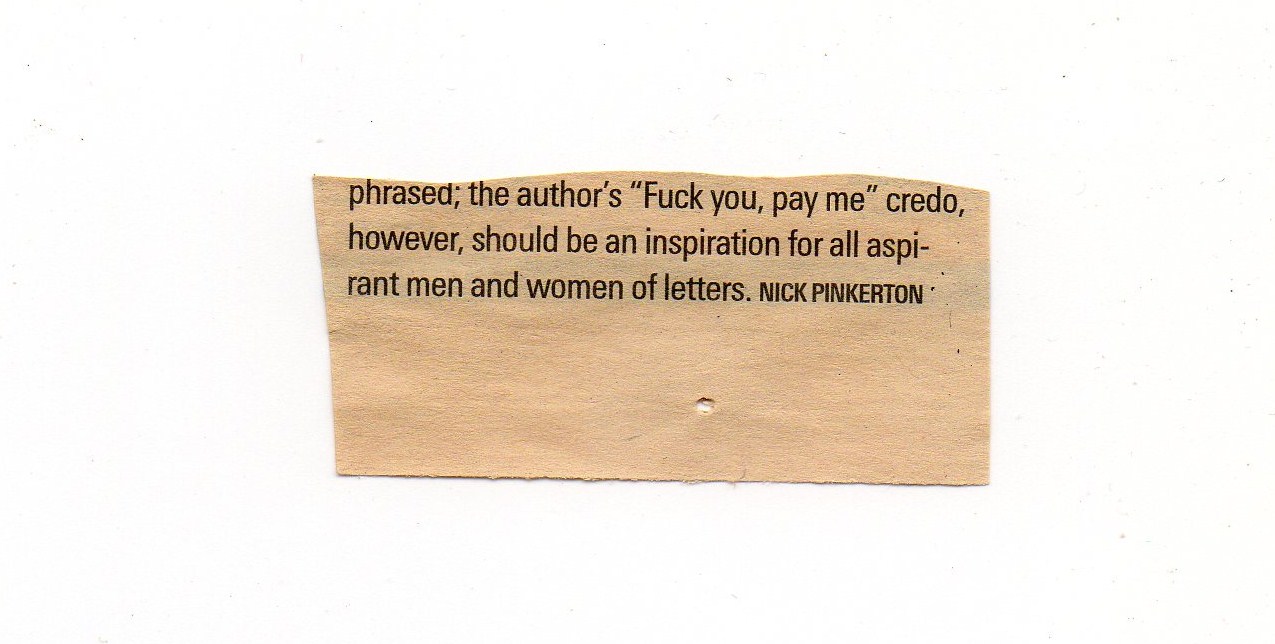
Crossover ephemera

14 07 2012

True or false, they have a human value, which, meaningless though it may be to an economist, is important to the historian.

—C.V. Wedgewood, The Thirty Years War, on the horrors of the war

(Since I plan to use this bit again, it’s not, strictly speaking, ephemera, but the quote did “float up” and off the page.)


I have heard a million tales; I have told a million more

9 03 2012

Been falling down on the blogging beat. . . and this post isn’t really going to rectify that.

Quick hits, nothing more.

~~~

Rush Limbaugh is boring. Bore bore bore boring.

I don’t care about his advertisers, I don’t care about a boycott, I don’t care if he disappears from the radio forever.

Yes, he was a total shit to Sandra Fluke, just as he was a total shit to Chelsea Clinton (and Hillary Clinton and Michelle Obama and. . .) and if he doesn’t understand that women can actually enjoy sex then I can only say “ur doing it wrong!!!”

But he lacks anything other than bile and ego, and as I have my own bile and ego, I see no reason to indulge his particular brand of narcissistic nonsense.

~~~

I did coupla’ posts a while back deriding the concept of “free” (put in quotes because it was about a price point which wasn’t really zero, just offloaded on to someone else), but the notion has reemerged in another form, as a kind of justification for theft of copyrighted materials.

As someone who participated in the SOPA/PIPA protest, who believes that copyright laws are waaaay overdue for an overhaul, and who doesn’t pay for the third-party content (videos, photos) that I post, I am as much in the moral muck—if not in as quite as deep as some—as my fellow. . . thieves.

Still, I am unmoved by the argument made by some that the delay in release of DVDs or streaming of movies justifies piracy. “I’m not getting what I want as soon as I want it” is less about copyright overreach and more about selfishness.

Anyway, I’m not so much interested in filling out that argument than I am in tossing out the following stray bits:

One, is not the justification for “free” (in either form) some kind of end-state of a labor-dismissing form of capitalism? That is,  value was first removed from labor (in the forms of laborers) and relocated to the anarchic (if manipulated) realm of supply-and-demand; now value is being removed from the production process itself, such that the costs of production are irrelevant to those who demand the end product for “free”.

All that matters is the desire of the consumer, to the detriment of the processes and relationships which enable the desire to be fulfilled.

Two, is the academic publication model in any way relevant to this conversation? Professors produce content for “free” (journal articles, conference papers) or nearly “free” (books, book chapters) as a price of admission into the academic guild.

Produce a sufficient number of these “freebies” and one is granted tenure, which in turn allows one  to produce more such “freebies”.

(Yes, there are salaries and teaching commitments and of course the horrid practice of making authors pay for their own reprints, but I don’t know that any of those throws off the comparison.)

~~~

Pundits have nothing to offer people who pay attention.

There’s nothing Cokie Roberts or David Brooks or EJ Dionne has to say that anyone who hasn’t been paying long and sustained attention to politics couldn’t have said for themselves.

Now, I happen to have particular contempt for Cokie Roberts (god, her smugness!), and I may have suggested once or twenty times that all pundits be loaded on to a cruise ship, sent out to sea, and never allowed to dock anywhere ever again, but a decent pundit actually has something to offer someone who wants a quick hit of info on a topic about which she knows little.

But pundits talking to pundits about their punditry? Useless.

~~~

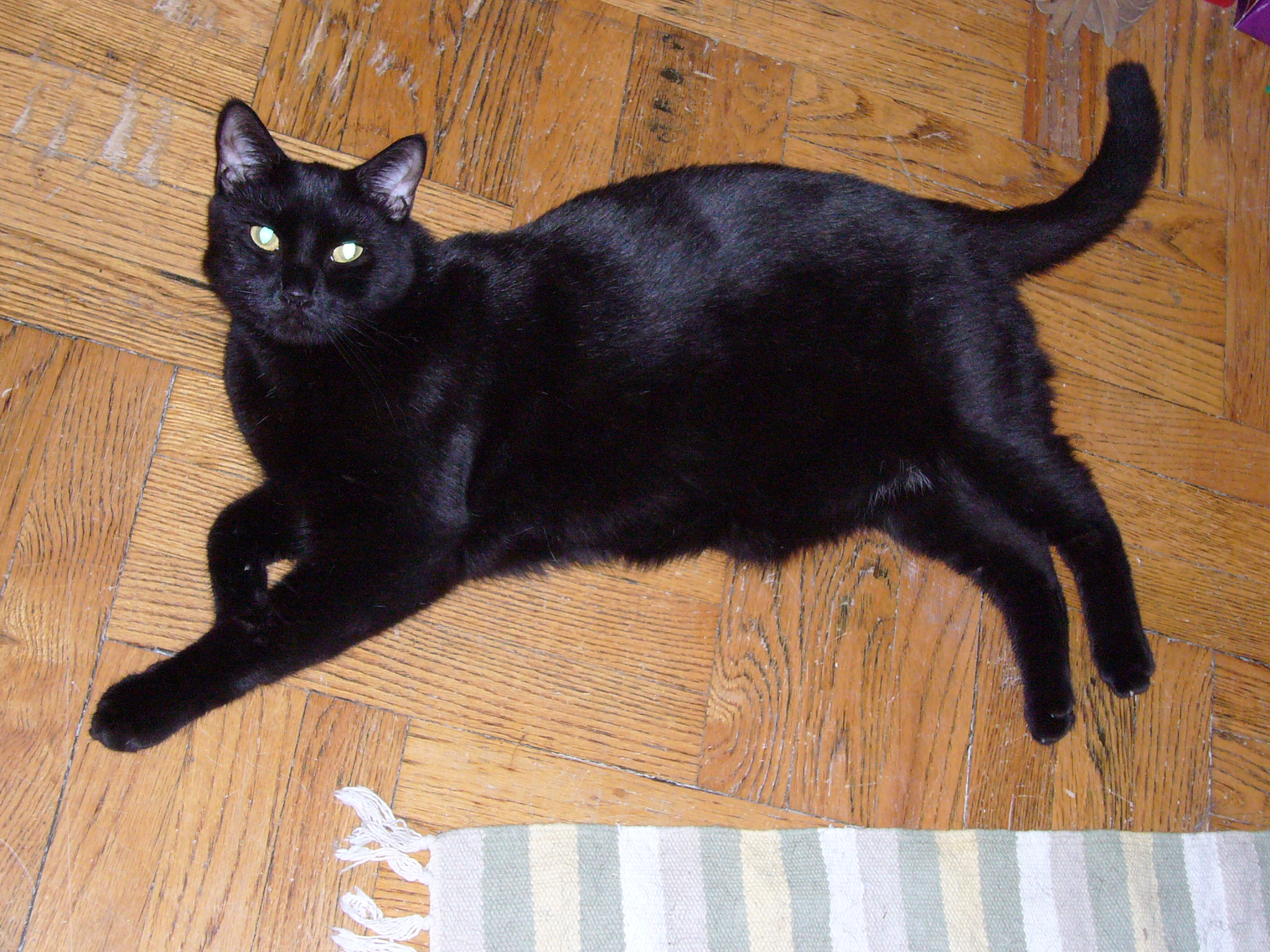
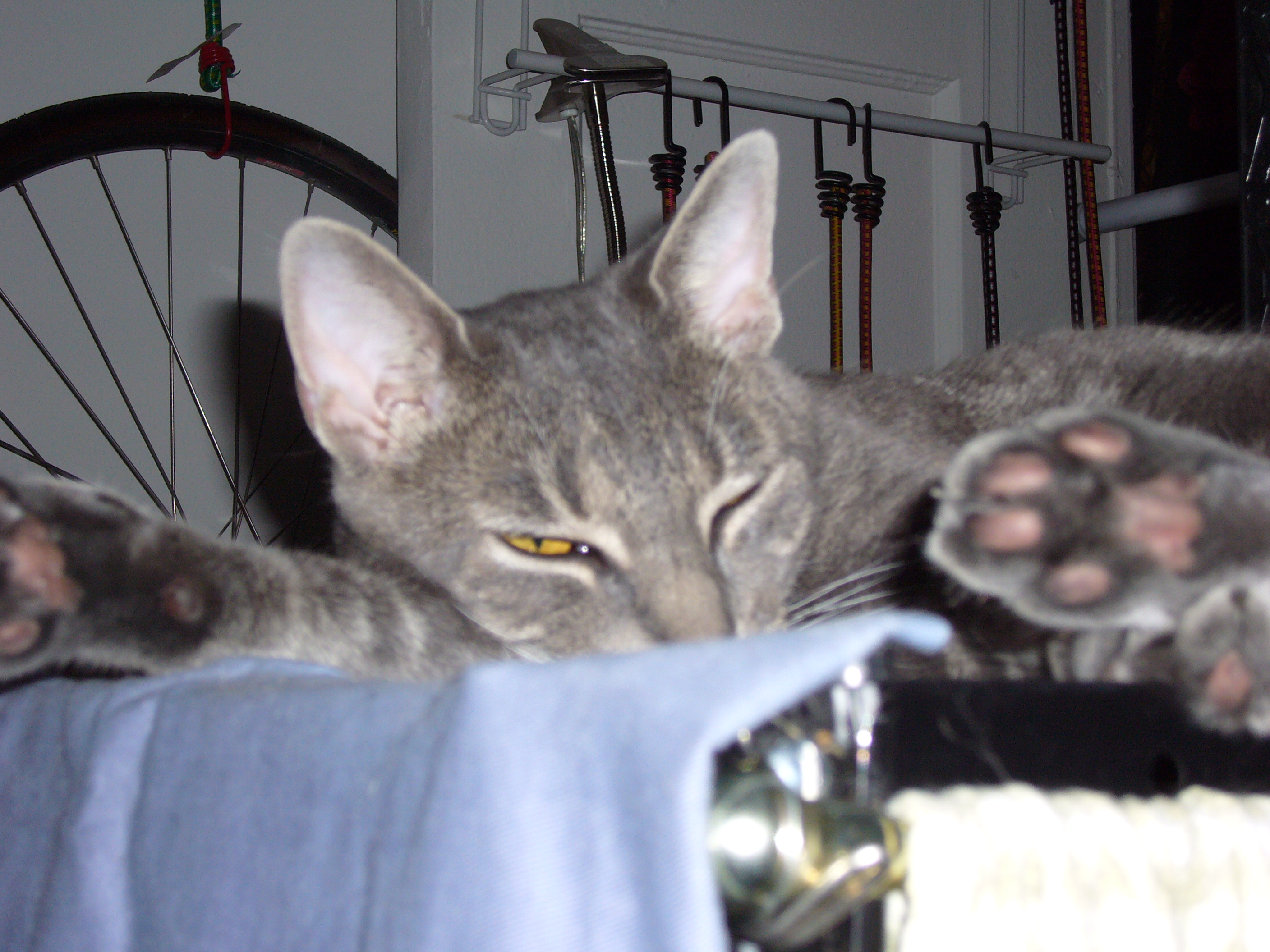
And because it’s been awhile, a coupla’ shots of the absurd household’s fuzzier denizens:

Catman! Catman! Catman! Nana nana nana nana CATMAN!

You have GOT to be kidding me.

Trouble, both of ’em.


One day it’s fine, the next it’s black

5 03 2012

Buncha thoughts, none of which currently coheres into an argument or essay:

Why should I have to pay for a woman to fuck without consequences?

An attack on women’s sexuality—yeah, yeah, nothing new—but the logic behind this bares not just hostility to women claiming their full humanity, but to insurance itself.

Why pay for contraception is a question that could be asked of any medical intervention. Why pay for Viagra is the obvious follow-up, but the underlying sentiment is why should I pay anything else for anyone for any reason?

Actually, that’s not just an attack on insurance, but on politics itself.

~~~

When to stay and when to go?

This is an ongoing conflict between my civic republican and anarchist sides: When should one fight to stay within any particular system, and when should one say I’m out?

One part of me wants the full range of women’s health services wholly ensconced in medical education and practice, an integral part of the medical establishment, and another part of me says Enough! We’ll do it ourselves!

I’ve mentioned that when I was in high school I helped to start an independent newspaper. We wanted to be in charge of what was covered and what was said, and decided that the only way to assert that control was to strike out on our own.

Given our options, given our willingness and our ability to do the work, and given what we wanted to accomplish, it was the right choice.

I’m not so sure that peeling ourselves off of the medical establishment would be anywhere near as good an idea, not least because the conditions are, shall we say, rather different from starting a newspaper; more to the point, what would be the point of such disestablishment?

In other words, what’s the best way for us to take care of ourselves?

~~~

For all my anarchist sympathies, I am not an anarchist, and my sympathies do not run in all directions.

I am not a fan of homeschooling, for example, and have at times argued that, in principle, it should not be allowed. I have at times argued that, in principle, no private K-12 education should be allowed.

I have principled reasons for these arguments, but, honestly, there is a fair amount of unreasoned hostility to such endeavors.

This is a problem.

No, not the contradiction, but the lack of reflection. If I’m going to go against myself, I ought at least know why.

~~~

I might be done with Rod Dreher.

I’ve followed Dreher on and off for years, first at BeliefNet, then at RealClearReligion, and now at American Conservative. He’s a self-declared “crunchy conservative”, writing about a kind of conservation care, community, and his own understandings of Orthodox Christianity. He also wrote quite movingly of his beloved sister Ruthie’s ultimately fatal struggle with lung cancer.

As an unrepentant leftist I think it’s important for me to read unrepentant rightists: not to get riled, but to try to understand. And Dreher, because he has so often been thoughtful about so many aspects of his own conservatism, has been a mostly welcoming guide to a worldview not my own.

More and more often, however, that thoughtfulness about his own side is being drowned by a contempt for the other side. This is not unexpected—one remains on a side because one thinks that side is better—but Dreher has turned into just another predictable culture warrior, launching full-scale attacks on the motives of the other side while huffily turning aside any questions regarding his own motives.

Perhaps he thinks the best way to deal with the alleged loss of standards is to double them.

And that, more than any political difference, is what is driving me away: he no longer writes in good faith.


You should be dancing, yeah

30 01 2012

Okay, that title has nothing to do with this post, but I’m listening to a WNYC program’s discussion of the Bee Gees, and they played this song, so, y’know, why not.

Anyway.

Classes begin tomorrow, and while I’ve taught all of these courses before and my syllabi are set, I’m always a bit nervous before the curtain rises. Last semester my bioethics course kicked ass and my American government course sucked ass, so I’m hoping to maintain the performance of the former while raising that of the latter.

I’m also teaching a course I haven’t taught for a couple of years, and I’ve rejiggered it somewhat from my last pass. It’s an intro to political theory course (more or less), and the last time out the students never truly engaged the material. I don’t know if it was them or me, but I do know I was rather listless by the end. This time around, I cut back a wee on the reading and reconfigured the written work; we’ll see if it works.

<<Oh, shit, I haven’t yet updated my course website. Dammit. Maybe tomorrow morning.>>

Is this all a way of excuse-making in advance for not posting as much as I should? Why, why would you even think such a thing?

Actually, the busier I am, the more likely I am to write, so who know: maybe I’ll be a bloggin’-machine this semester.

~~~

I need to get some real writing done, too. The Unexpected Neighbor is already e-pubbed (link at right), but I stopped in the midst of editing Home Away Home. I really should get back to it, not least because it’s a better manuscript than Neighbor, but also because once I finish that, I’ll have no excuses for not working on my next project. If only I could settle on that next project.

Anyway, here are bits from Home, the first, in honor of the previous post:

Kurt had taken Jamie for a ‘walk-and-talk’ before his son left for Daytona. ‘I know we talked about this before, and I know you’ve been living away from home for awhile now, but I don’t want you to get in any trouble in Florida.’
Jamie tugged on his ponytail, trying to keep a smile off his face.
Kurt noticed. ‘I know, you think this is funny, and your old man is way behind, but James, seriously, a person does things on vacation that, that he wouldn’t do at home.’
‘Dad!’ Jamie looked at his father. ‘What do you think I’m going to do?’
Kurt took a deep breath. ‘Well, Rachel is going to Florida, too, isn’t she?’
Jamie laughed. ‘Jeez, dad. She’s staying in another hotel from us guys.’
‘She’s been staying on another floor from you in the dorm, but that hasn’t stopped you, has it?’ Kurt kicked aside a melting chunk of ice.
Jamie said nothing.
‘Look, Jamie, I know you’re not a stupid kid, and I assume you and Rachel have been. . . smart about. . . your relationship.’ Kurt shuffled around more ice pebbles. ‘But Florida, the beach, the booze, everything—your common sense can fly right out the window.’
Jamie scratched his still-unshaven face. ‘Dad, don’t worry. I can handle it.’
‘And no drugs. All right? No drugs.’ Kurt continued as if he hadn’t heard Jamie. ‘You don’t know what kids can do on those things.’
Jamie paused behind a large ice chunk, retreated a few steps, then ran and kicked it down the path. ‘I’m in college, dad, all right? None of this stuff is new.’ He tapped his boot free of slush. ‘Besides, you’ve met Rachel, right? She’s not exactly Janis Joplin.’
Kurt stopped. ‘Janis Joplin? Kids still listen to her?’
‘They listen to all that sixties crap.’ Jamie walked ahead of his dad. ‘Well, Rachel loves Janis, so I can’t call her crap, but, you know.’
Kurt double-stepped to catch up to Jamie. ‘She’s not, she’s not like Janis, is she?’
‘Dad! I just told you. Jeez.’ Jamie looked at Kurt, shaking his head. ‘She’s a chem major, for crying out loud. That’s super hard.’
Kurt nodded. They ambled along the gravel path in silence. ‘Have you picked a major?’
‘I was thinking math, but, I don’t know.’ Jamie hitched up his back pack. ‘I don’t think so. I got time. Maybe sociology. Journalism.’ He looked sideways at his dad. ‘Those aren’t very hard majors, are they? I mean, compared to chemistry. Or philosophy.’
Jamie was now staring ahead, his cheeks reddening. Kurt rested his hand on Jamie’s nearest shoulder, and leaned into his son. ‘Do what makes you happy, James, and do it well. That’s what matters.’ He moved his hand under Jamie’s ponytail. ‘The rest will take care of itself.’

And the second bit:

Summers in Madison alternated between the glorious and the brutal. There were days Maggie would borrow Laura’s bike and tool along Lakeshore path, cooled by the shade and the breeze from Lake Mendota, and other days when a dip in Lake Wingra felt like taking a warm bath. ‘I get cooler going under and standing up than staying in,’ Maggie said to Laura.
‘I know,’ Laura responded. ‘I’m in the water and I’m sweating. This is ridiculous.’
On those nights they’d set up cots on the back porch for sleep, the humidity making them careless if the neighbors saw them in their underwear. ‘I’d go naked if I thought it’d make a difference,’ Laura declared.
Maggie only smiled. ‘We used to sleep in the basement.’ She handed a beer to Laura, and flipped the tab of her can. ‘It was nice, though. Not like the dungeon here.’
Laura turned the can away from her as she opened it. ‘No shit. I don’t even like going down there in the day.’ She put her mouth over the fulminating beer. ‘Too bad we can’t turn it into a pool.’
‘That’d be nice,’ Maggie agreed. ‘Sleep on air mattresses.’
‘Pfft, those things leak.’ Laura pushed her cot against the wall then slouched against the boards. Her dyed black hair was piled on top of her head, and she held the cold can against her pale neck. ‘So you’d sleep in the basement, huh? You usually don’t talk about your life before here.’
Maggie was wedged in the opposite corner, her beer on the railing next to her. ‘Yeah, well.’
‘So what’s the deal?’
Maggie peered through the stiles at the backyard trees. ‘I don’t, uh, I don’t really have much contact with anyone.’
‘Bad?’
Maggie pulled her beer back to her belly, setting it on the exposed skin between her cut-off t-shirt and underwear. ‘Not really. It’s just, I left, you know, after graduation. Needed time to myself.’ She brushed the condensation into her belly button.
Laura looked over to her. ‘Does your family know you’re here?’
‘Not really. I mean, maybe they figured it out.’ Maggie yawned. ‘I was born here, and I wanted to come to school here, so maybe they know.’
‘But you haven’t called them or anything?’ Laura was staring at Maggie.
Maggie avoided her gaze. ‘Nope.’
‘Wow. You just left?’
‘Yep.’
Laura took a long drink, then let out a long belch. ‘Wake up, everybody!’ she laughed. Then she frowned. ‘I don’t know if I could do that. My dad and I fight all the time—you’ve heard me, on the phone—but, jeez, not talking to him? And it would kill my mom.’ Laura’s family lived about nearby, just on the other side of Sun Prairie; she was the second of three children. ‘Do you have brothers or sisters?’
Maggie continued to squeegee the water off the can. ‘Yeah.’
‘And they don’t know where you are, either?’
Maggie shrugged. ‘Well, my older brother, you know, he was at school last year, and he’s never around, so I bet he doesn’t really notice. And my younger brother and sister, they’re really young.’
‘So nobody knows you’re here?’ Laura was now sitting cross-legged on her cot, looking directly at Maggie.
Maggie sipped her beer. ‘Not really. I called my friend Colleen the other day—which reminds me, I gotta write down the number—but I didn’t tell her I was here.’ She peered up at Laura. ‘It’s just easier that way, you know?’
Laura was shaking her head. ‘I don’t know, Mags. I think they must be going a little crazy.’ She peered down into her can. ‘What if they think you’re dead or something?’
Maggie waved her off. ‘Oh, I left them a note. Told them I was leaving, I was fine. Had money saved, the whole thing.’ She paused, drinking her beer. ‘Just wanted to be on my own for awhile.’
‘I don’t know.’ Laura squinted at her. ‘That’s pretty rough.’
Maggie raised her eyebrows. ‘They’re fine. We weren’t getting along. They’re probably relieved I’m out of their hair.’
‘I don’t know,’ Laura repeated. ‘I think maybe you’re making a mistake.’ She swirled her beer. ‘But hey, it’s your life.’ She took a drink, and grimaced. ‘Shit. Even the beer can’t stay cold.’
Maggie raised her can and laughed. ‘Just gotta drink it faster.’ She chugged the rest of it down, paused, then burped. ‘Then you can taste it, twice.’
‘Gross.’ But Laura finished off her beer as well. She stood up, and held out her hand for Maggie’s can. ‘Want another?’
Maggie shook her head. ‘Nah. It just makes me sweat.’
Laura stood at the door. ‘You ever going to go back?’
‘I don’t know.’ Maggie turned and looked up at Laura. ‘Maybe. I don’t know.’
Laura held up her hands. ‘Like I said, it’s your life.’

I’m not giving anything away in these excerpts: You figure out very quickly that someone—Maggie—who was long gone has now been found, and then are sent back for the story leading up to that point; the narrative catches up to the first page by the middle of the book, and goes from there.

A friend who read the earlier draft wasn’t convinced that someone would just leave home and never look back, but oh, haven’t there been times when you wanted to keep going, just (to steal a line from Neighbor) to see how far you could go?


Where was I?

29 12 2011

No work, not enough work, too much work, work.

That’s been the last six months. Nowhere near enough money, even with too much work (really blew it on this last freelance job—shoulda charged double), but now things to be evening out: three courses for the spring, half-time admin work for a local-international organization.

I have some idea of what I’ll be doing with the teaching, no clue on what exactly I need to do with the admin work, but hey, I’ve gone from clueless to clue-full before.

~~~

Hey, I’ve got some a few new readers! HI!

Thanks for poking your head through my window! I’ll try not to slam it down on your noggin’. . . .

(And yes, I’ll return the favor and check out your blogs as well, now that I have the time to do so.)

~~~

I really hate not knowing things.

The problem, of course, is that the more I learn, the more I learn what I don’t know. Frustrating, that.

And embarrassing. Before I embarked on my jaunt through the European medieval period, I knew nothing about this history. Nothing.

Oh, something about the break with the Eastern Church in the 11th century, and Luther in the 1500s, but I couldn’t have told you the difference between the Renaissance and the Enlightenment, or between the various emperors and the pope.

Yeah, it was bad.

So now I’m learning stuff (yay!), but I’m running up against the parameters that I had initially set for this project. It was conceived as an investigation of intellectual history, with not much room for social (writ large) history, but I’m too much of a materialist to dismiss the conditions (see below) under which these ideas were generated and spread.

This is a very long way of thanking petefrombaltimore for his suggestions in reading.

Yes, a project like this can sprawl out over any boundaries set—hence my initial attempts at capturing only intellectual history—but sometimes the most interesting bits are discovered in the spillage.

Anyway, I just finished Peter Gay’s The Enlightenment and am now on Diarmaid MacCulloch’s The Reformation; I may then mix in some close-up histories, as well as tackling some of the primary sources.

Can’t say I’ve yet gotten anything solid on the late-margins of modernity by poking around in the early margins, but I am still poking along.

~~~

Got my first round of applause for teaching in. . . ever?

It was for my bioethics course, a class which was terrible the first time I taught it (at another university), pretty good the first time I taught it here, and now, well, good. I’ll continue to tweak it as I go along, but I’ve got a solid set-up which should hold for at least another few semesters.

It’s much easier to keep teaching the same thing over and over—all that prep work is already done—but I get antsy. I don’t think there’s a perfect syllabus or course (see: not a Platonist), so after a certain number of repetitions I overhaul the course to try to capture something missing from the previous go-around.

It’s not always better, and almost always requires adjustment, but it keeps me thinking.

Anyway, the applause.

It was common at UW-Madison to applaud professors at the end of the semester. Most of my classes were large lectures, so the performative aspect of teaching was more apparent than in seminars, but classes were similarly large at Minnesota, and I don’t recall the students applauding professors there.

It’s nice, both to applaud and be applauded. I liked that I could show my appreciation for a good professor (or lack thereof with tepid clapping); it seemed to signal that there was something more going on in that lecture hall than a contractual transmission of information from instructor to user.

The best professors gave us knowledge far and beyond that necessary for a good grade: they gave us an appreciation for the wonder of knowing.

I don’t know if that’s what my students were applauding. I work hard to tamp down my urge to overwhelm them with my words—as the person who constructs the syllabus and leads the discussions, I already have great, if indirect, influence on how they approach the subject—but on this last day of class I gave them a concentrated shot of my approach to bioethics.

I started with a truncated version of the epistemology/ontology/practical lecture, zeroing in on the significance of being (or Being, if you please) in one’s understanding of practical ethics. I then moved on to Hannah Arendt’s distinction between human nature and the human condition, namely, that while we cannot with any certainty know our nature, we can approach our condition.

And the most basic of our conditions are that we are biological beings, we are social beings, and we are mortal beings. We may be more than this, I noted (spiritual, philosophical, etc.), but we are damned-near-incontestably conditioned by our biology, our relationships to others, and the fact that we are born and will some day die.

This matters to bioethics, I argued, because any ethics which does not take account of these conditions cannot be of any practical worth.

(You might think that this would be so obvious as to be banal, but it is not.)

I can’t tell you that consequentialism or deontological ethics or casuistry or any other way is the correct approach, I said. We need standards to keep us from justification-by-convenience, to force a critical appraisal of our actions, but, pace our conditions, we have to allow deviation from those standards: the rules are to serve the human, not the human, the rules.

Finally, I said, circling back around, this is where I center my ethics, on the matter of  human being. What makes us who we are, and what we could become? It’s not that our abilities have to be unique among species, but we should think about ourselves, as humans, in how we approach one another.

We don’t have to be heroes, I observed. It’s not about pulling someone out of a burning car or tackling the bad guy or dodging bullets; it’s about recognizing one another as humans.

And then I told the story of a group of people in a small town in Wisconsin who decided to hold a funeral for an unknown woman who had been found, murdered, in their town. She wasn’t one of their own, and would never know what had been done for her, but through the donations of the funeral home and money raised for a plot and marker, and in the service at the cemetery, these people did in fact claim her as one of their own.

There was nothing heroic in this ordinary act of burying the dead, but by taking care of this dead woman’s body, they recognized her as one of them; they demonstrated their humanity in their recognition of her humanity.

We can take care of one another, I said. Our ethics ought to be centered on how we take care of one another.

They seemed to like that. I didn’t expect the applause—I thought I had gone too far—but even if I had, they didn’t seem to mind.

It was nice.

~~~

As a coda, I’ve consolidated my earwig approach to teaching (“I want this stuff to bother you for the rest of your lives”) into a line stolen and adapted from Serenity:

I aim to trouble you.

It’s not me, really, who can do this, but I can bring the trouble of politics and theory and ethics to my students, and hope that it disturbs them a good long time.

Talkin’ at the Texaco

2 10 2011

Kitty boy is not out of the woods.

He seems to get better, then, ohp, back the other way. He’s not in crisis, but that the improvement isn’t steady concerns me. I’m trying a variety of home remedies—yes, even after taking in the admonitions for a vet to check him out—which likely have a good shot at taking care of him. That’s the good news.

The bad news is that this problem will likely recur, such that prevention will have to be worked into his everyday diet. He needs to drink more water and I need to increase his acid intake.

Here’s hopin’ Jasper gets used to salt and cranberries.

~~~~~

Good weekend for sports in Wisconsin.

Badgers rolled over Nebraska, Brewers are up 2-0 in their 5-game series with the Diamondbacks, and the Packers remain undefeated.

I am deeply ambivalent about sports—brand loyalty is for suckers, blah blah—and in particular, about football, and the evident harm it inflicts on the players. Thus, the cheering isn’t as full-throated as it was in the past, but it’s still there.

Maybe someday I’ll be enlightened enough to let it all go, but in the meantime. . . .

~~~~~

Thanks to Brad DeLong, I was hipped to John Holbo and Belle Waring’s equine-eviseration of libertarianism:

Now, everyone close your eyes and try to imagine a private, profit-making rights-enforcement organization which does not resemble the mafia, a street gang, those pesky fire-fighters/arsonists/looters who used to provide such “services” in old New York and Tokyo, medieval tax-farmers, or a Lendu militia. (In general, if thoughts of the Eastern Congo intrude, I suggest waving them away with the invisible hand and repeating “that’s anarcho-capitalism” several times.) Nothing’s happening but a buzzing noise, right?

Now try it the wishful thinking way. Just wish that we might all live in a state of perfect liberty, free of taxation and intrusive government, and that we should all be wealthier as well as freer. Now wish that people should, despite that lack of any restraint on their actions such as might be formed by policemen, functioning law courts, the SEC, and so on, not spend all their time screwing each other in predictable ways ranging from ordinary rape, through the selling of fraudulent stocks in non-existent ventures, up to the wholesale dumping of mercury in the public water supplies. (I mean, the general stock of water from which people privately draw.) Awesome huh? But it gets better. Now wish that everyone had a pony. Don’t thank me, Thank John.

The and-a-pony bit is explained earlier in the piece; g’head and read the whole thing.

Once again: libertarianism is not a serious political theory; it is at best an adjunct to serious political theory.

~~~~~

I’ve noted in the past that an over-concentration on process to the neglect of substance bleeds politics dry of its very purpose. That said, some attention to process may fruitfully obstruct an over-concentration on ends.

See, for example, presidential freelancing in the so-called war on terror.

President Bush stepped up the use of extraordinary rendition and justified the imprisonment and torture of detainees (even as he denied that beatings, waterboarding, and sleep deprivation were torture) as necessary to securing the dominance security of the United States. He was hailed on the right, booed on the left, and denounced by libertarians of all stripes (n.b.: see, I can say nice things about libertarians!).

President Obama has allegedly stopped the torture and has tried, with varying amounts of effort, to close Guantanamo. He has also authorized far more drone strikes on militant leaders than President Bush ever did, and hailed the assassination of American citizen Anwar al-Awlaki as “another significant milestone in the broader effort to defeat Al Qaeda and its affiliates.” (He presumably did not mourn the death of Samir Khan, another American citizen killed alongside al-Awlaki.) He has been (mutedly) hailed on the right, (mutedly) booed on the left, and denounced by libertarians of all stripes.

I’m not particularly a fan of either al-Awlaki or Khan—violent hatred of the world isn’t my thing—and I do think the citizenship status of al-Awlaki and Khan (and John Walker Lindh and Jose Padilla, for that matter) ought to give any American pause regarding their officially-sanctioned killing. (I leave aside the question of whether the Constitution covers noncitizens; my understanding is that this question is unsettled, juridically.)

But even if you don’t think the 5th Amendment applies in this case, nor that the citizenship of al-Awlaki or Khan matters, what of the matter of presidential power?

Obama apparently consulted with various staffers and legal experts on the legitimacy of such assassinations, but is a consult with one’s staff an apt substitute for legislative debate? Is it enough for the president to say “it’s okay because I say it’s okay”?

And because it was only bad guys who were killed, then, hey, that’s okay, too? Ends justifying the means, and all.

If pure proceduralism is deadly to politics, so too is pure consequentialism—especially in its democratic forms.

~~~~~

Whine whine whine about my life. What am I doing, here I am flailing, here I am failing, what if I moved. . . .

No.

I don’t know if I’ll be in New York forever, but I do know that this is where I need to make my stand. If I were to move anywhere else, it would be too easy to say “oh, if only I were in New York. . .”, and distract myself from the work I need to do.

I am so far past “enough” that I have lapped myself; still, if I’m ever to catch up, I have to stop jumping away from my life.


In between all the cracks upon the wall

31 08 2011

Coupla’ thoughts:

1. I know I am not the first to take up the issue of the twilight of labor (or, to put it less poetically, of the replacement of the value of labor with that of productivity)—this gent Marx may have had a thing or two to say on this subject, or so I hear—but it seems to be crucially not simply an economic matter but a political one, that is, that the question of value is not simply an economic matter but a political one.

Fred Clark at Slacktivist has covered this issue ( start here, then click on the “class warfare” category at the bottom for more) and ThinkProgress does a pretty good job highlighting the contempt for working people among politicians and some pundits, so I don’t know that I need to repeat their efforts (or those of the Economic Policy Institute, The Nation, and other usual suspects) in documenting this contempt.

Still, because this seems to me to be a crucial political issue, I do feel the need to work through this issue myself. Is this contempt new? When did it begin? How did it manifest itself previously? What kind of pushback was there? Does the contempt arise mainly from the right, or are the politics of it more complicated? Is contempt even the best way to describe the attitude toward labor? What kind of variation is there across different forms of labor? And, perhaps most urgently, how to respond to the replacement of labor with productivity, that is, to the erasure of labor itself?

This might be a way for me to approach this subject without having to take an econometric approach. I’ve held back on getting into this both because I lack training in economics and because econometrics won’t necessarily get to what really matters about this issue. In other words, I want to consider this as a political matter, not an economic one.

And it is a political matter, a deeply political matter. We Americans have managed historically to suppress and mollify labor in turn, but in the last thirty years the grudging acceptance of labor has turned into a grudge, full stop, and labor consciousness itself  has been dissolved. Why this matters, politically, well, that’s what I’m going to have to figure out.

2. I snarked the other day at TNC’s joint that libertarianism is not a real political philosophy, but didn’t say much beyond that. Later, prior to reading Isaiah Berlin’s “Two Concept of Liberty”, I wrote that as a

general matter, I dismiss libertarianism as a serious theory of governance, not least b/c it appears to have contempt even for the notion of government, that is, as a form of organization over and above civil society. Instead, I posit, its chief use is as a critique or as a leavening agent to various legitimate political theories. In short, I question its ability to provide any sort of overriding guidance to those charged w/governing, its applicability to any sort of society beyond a small, like-minded group (i.e., fails test of pluralism – this charge of anti-pluralism requires particular care), or its ability to last beyond a generation or two w/o dissolution or degenerating into authoritarianism.

All find and good; there’s something for me to work with, here, But then I realized:

Okay, but what of the critique of Marxism as lacking a serious theory of government? Could not the same charged [sic] be lodged against it – that it works as a critique or adjunct to Liberal theories, but that it, too, exhibits its own kind of contempt for govt? Gramsci might offer one kind of response, but even there. . . .

I then headed into a dead end, backed out, and wondered

Perhaps, then, the question of whether libertarianism or Marxism offers its own theory of democratic (understood broadly) governance? And it not, why do I take Marxism seriously in a way I don’t take libertarianism?

I’m fine going after libertarianism, not least because its noxious fumes are currently polluting the political air, but for my own sake, I gotta take up at some point that question of what would a socialist government look like.

3. Those candidates who insist that nothing good comes from government need to be forced to explain how they will govern. Cut cut cut ought not be accepted as a governing philosophy, and opponents to these anti-government politicians should hammer them on what they will do, besides less-than-nothing.

4. I really was not able to put together a coherent post tonight, but I thought if I didn’t get these thoughts out, I wouldn’t get these thoughts out.


More stuff from my bulletin board

9 08 2011

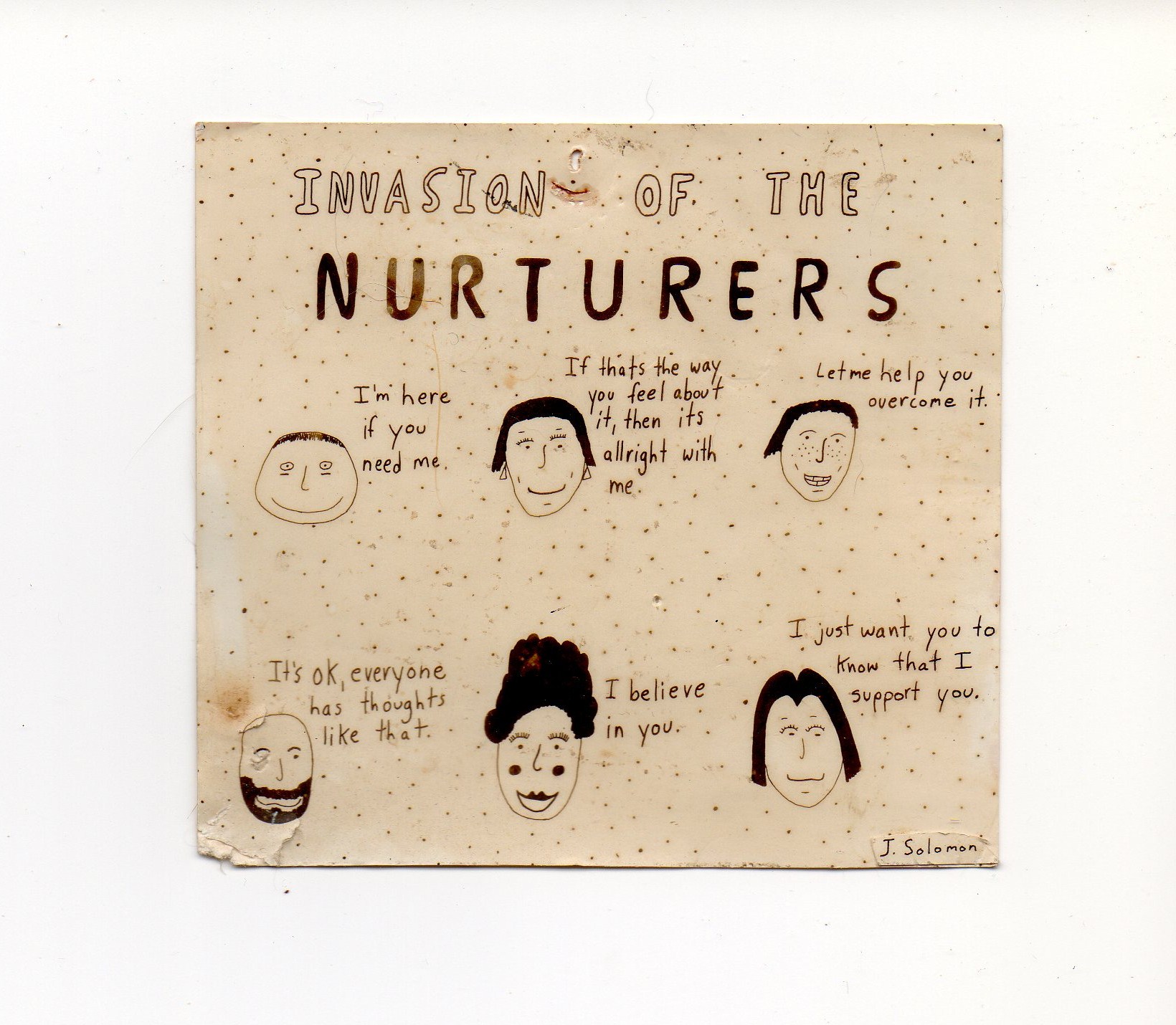
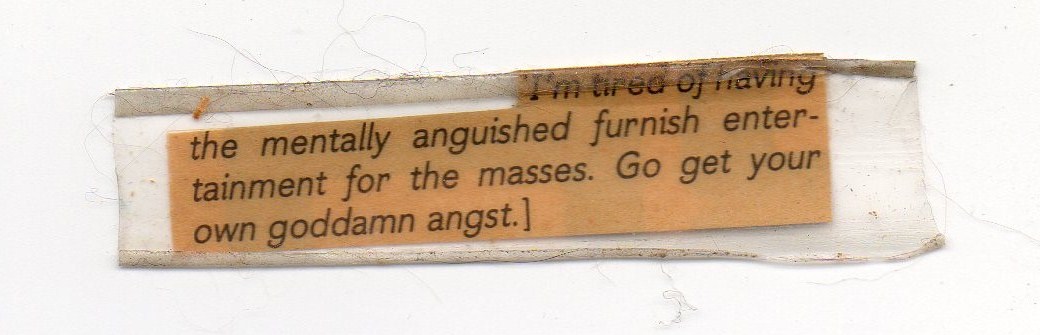
J. Solomon, from an old (late 1980s) Daily Cardinal. This is the waxed version, lifted off the page (after it went to print) one of the nights I served as night editor.

I gave a copy of it to my therapist at the time; she was amused.

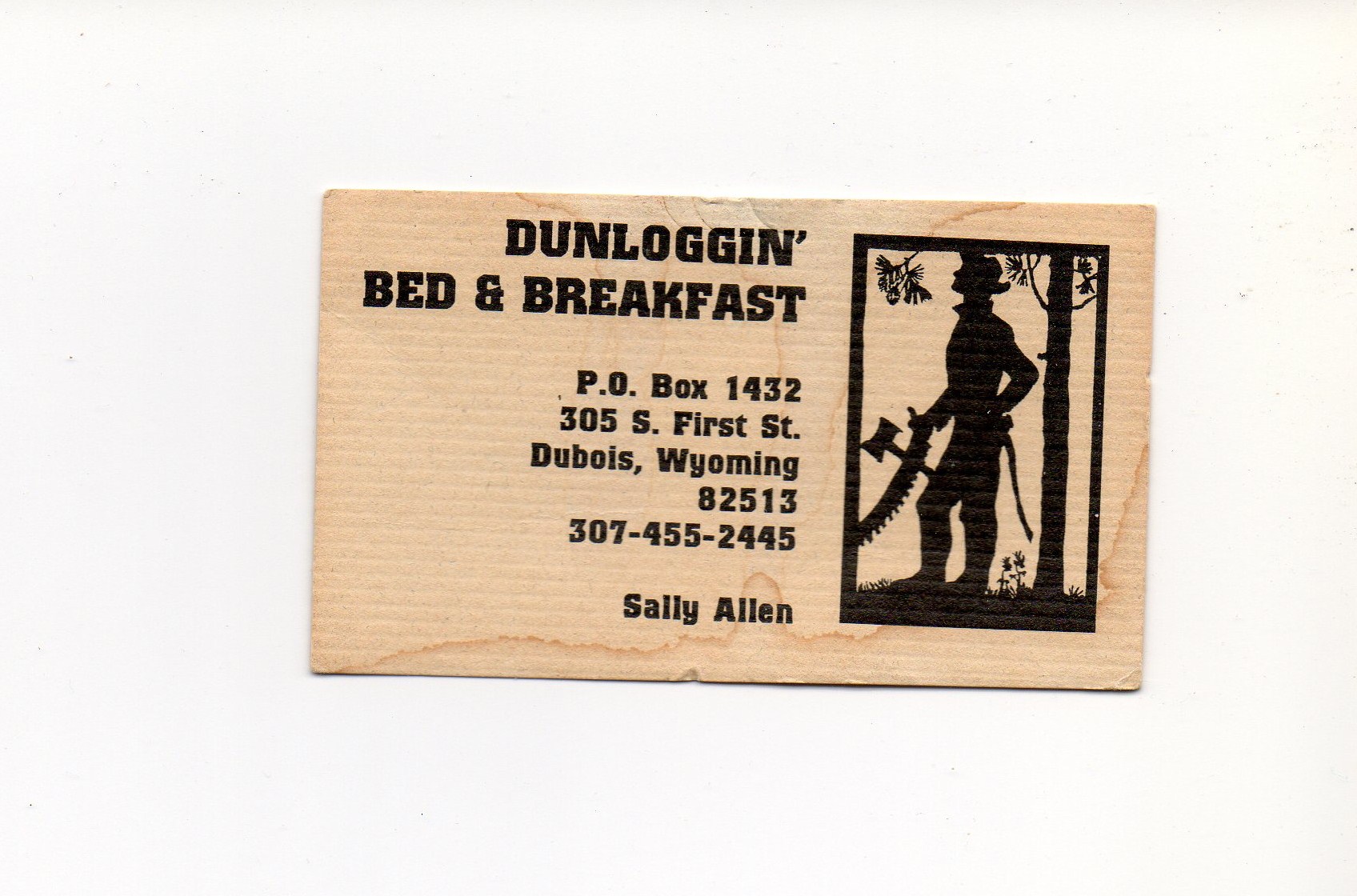
From a mid-1990s trip west with L., S., and J. Sally told us about her son in Minneapolis, and encouraged us to get our own coffee (which we then offered to other diners at her fine establishment). Other locals regaled us with tales of stupid tourists, which we, as presumably not-stupid tourists, greatly enjoyed.

S. thought she had a tick and asked me to check her head. I saw something, but didn’t think it was a tick. I told her to check it out. (Later, when I found out that ticks aren’t always black or brown, I thought, Oh, that might have been a tick.)

Dubois is on the way out of Yellowstone Grand Tetons National Park and is, of course, pronounced Do-boys.

Self-explanatory. Don’t think I ever wore it, though. I think it’s only ever been on my bulletin board.

I think this one was pulled from the Madison weekly—The Isthmus, I think.

Or it coulda been from the Twin Cities Reader.

Either way, I was full of mental anguish at the time.

Really wish I hadn’t cut off the person quoted. I think this is from the Village Voice.

First time I heard this basic philosophy expressed in so pithy a manner.

I do like it.

From L., I think.

And, just because.


For the hell of it

8 08 2011

This quote, which I tore out of an old City Pages and which has graced my bulletin board since, mm, the late 1990s, was meant to lead off a post on the riots in London.

And then I remembered that I don’t know fuck-all what’s going on over there and should just keep my trap shut.

But the tear-out? It stands on its own.


This is for the wuc

3 08 2011

Ronnie Cheung, combat instructor, via Nick Harkaway’s The Gone-Away World:

“That was crap,” Ronnie Cheung says, it was total crap. Are you some kind of huge-testicled ballet dancer under that uniform? Are you a fucking chorus girl in a red beret? If I strip you off, Sergeant Hordle, and don’t snigger because I can and we both know it, if I strip you down to your skivvies with my own two hands, which I wouldn’t, because I don’t know where you’ve been, but I have thoughts, will I find that you are wearing stockings and a bloody tutu? And lest you think, Sergeant, that I am impugning your sexuality, let me remind you that Billy Radigand from C Company was in here half an hour ago and nearly took my bloody head off and he is a poof, not to say a homosexual, not to say he sups on sausage rather than fish, but he is hard as nails! And you are softer than a baby’s arse! Now fuck off and practise!”

Hard not to like the guy.