Baby, it’s cold outside

13 10 2009

I may have mentioned once or twice my. . . displeasure with summer.

Displeasure, hah! Fear, loathing, hatred—you know, the normal responses to sun and heat.

But fall, ah, blissful fall: crisp air, brisk winds, long nights, prelude to winter and all its bluster.

Who could hate the impending onset of weather which chases you down the street and into your apartment? Which welcomes your boots and mittens, gives way to your willingness to test yourself against its cold?

Winter: time of laughter and ease.

Unlike summer, which teases you outside and seduces you into believing the sun is your friend. The sun is not. It tolerates you in June, turns contemptuous in July, and, along with its collaborator, humidity, tries to kill you in August. The only way to survive is to hunker down in a dark space in front of a fan or air conditioner.

Winter respects its denizens; summer mocks them.

What set off this (rather pedestrian) reverie? The heat in the apartment has kicked in.

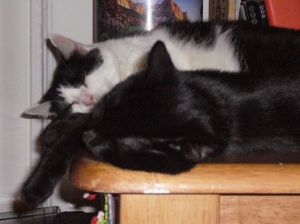
I don’t even have radiators, but the steam knocks so horribly in the bathroom pipe that it’ll wake me up—and has already freaked out Jasper. (Bean, used to noisy heat, barely stirs in her sleep.) Still, the sound signals the onset of warmth, the invitation to cozy up with. . .all right, I don’t have a companion, but a book or a cat. With a whiskey.

Waiiiit a minute, you might ask: You spent how many words bitching about the heat of summer, how it traps you inside, and here you are rhapsodizing over. . . indoor heat?

You’re clearly missing the point. It’s about an attitude, a set of possibilities, of the ability to carry one’s warmth outside and thus the freedom to move about, unlike in summer’s tyranny, which makes no allowances for bringing the cool with you.

Oh, never mind. You’re a summer person, aren’t you?


Closing walls and ticking clocks

11 10 2009

It was my twenti-mhtph class reunion last night.

I didn’t go.

But I did get to talk to folks who were at the reunion. T. called me amidst it all, then passed the phone to one person after another.

It was very loud.

I’m not sad I wasn’t there. I managed to miss all previous reunions, and, unlike in previous years, I wouldn’t have minded attending, but a trip back to SmallTown just was not happening.

B. filled me in a bit, today. I try to remember to call all of my friends and family members on or near their birthdays; B.’s day fell on a mad grading day, so it wasn’t until this weekend that we managed to connect. Anyway, she noted that a lot of people looked much the same as they had, some of the guys had gotten fat, one woman looked really, really old, and one of our classmates had gone completely around the bend.

Cameras-in-the-forest, president-not-born-in-US around the bend.

Everyone else seemed to have retained his or her sanity, however, and even Mr. Alternate Reality apparently entertained more than he offended. (It also apparently helped that another classmate basically served as his minder.)

So we’re halfway to the end. Does this make us old, or young? We are, thank the gods, no longer teenagers, but are we old? We ache and dye our hair and talk about our health, but we still have hair to dye and health to discuss, and we’re mobile enough that we can generate aches.

We’re forty-xmpthish: One lifetime down, one to go. Does that seem like so much more or not much more?

Who knows. It’s all we’ve got.

It’ll have to do.


One thing leads to another

9 10 2009

It’s happened again.

I finish one novel, wait, start another one. Then a new set of characters pushes into my words, and the new idea is set aside as a completely different novel unfolds.

I don’t understand it, but I go with it.

_____

So the President has won the Nobel Peace Prize.

I’m among those who wonders a bit about this, but I have a hard time seeing a downside.

This nearsightedness would apparently disqualify me from a career as a pundit, insofar as the bright lights of blovi-nation have deemed this as ‘having no upside’ (Mark Halperin, Time), as damaging (Mika Brzezinski), and a couple (George Packer, Mickey Kaus) suggesting he turn it down.

Yeah, because that would accomplish. . . what, exactly?

I’m not much of a nationalist, which, depending upon one’s definition, may mean I’m not much of a patriot, but why are all these ostensible America-Firsters so opposed to having something good come to US president?

_____

Biter Boy still bites. Not as often—not nearly as often—but even as he nears the end of teething (all four adult fangs are now in) he chomps more than he should.

Oh, and he knocked over his first plant this morning. Pissed me off, led to some, mmm, yelling, but as I was plopping the plant back into the pot, I remembered that Bean and Chelsea had their own bad encounters with their leafy co-inhabitants.

Jasper is also in full bathroom-fixation mode. Into the sink, sniffing the faucet. Running into the tub after I open the door after a shower, to watch the water finish its slow slide down the drain. And every time he hears me use the facilities he runs to inspect the process—sometimes to mildly distasteful results.

I should note that his fascination is strictly observatory: he does not appreciate forced participation in bathing.

_____

I hate grading. Have I mentioned that?

That’s the one, big, drawback to working at a community college: no teaching assistants on whom I can offload the papers.

_____

I’m not much either for Twitter or Miley Cyrus, but jeez Louise, even I took note that Stage Dad Billy Ray is pushing for her to, uh, what the hell’s the story? Oh, yeah, she shut down her Twitter account, and Mr. I-Miss-the-Limelight is begging for her return.

Excellent idea, ’cause I’m sure the SIXTEEN-YEAR-OLD girl doesn’t have enough to do, what with going to school, starring in a t.v. show, promoting an album, and whatever else an over-scheduled future-rehab patient does.

Now that’s some fine parenting.

_____

Your socialist-feminist-pomo-cranky blogger is. . . looking for corporate work.

Baby needs a new pair of shoes.

_____

C.’s got a new post up at SoundofRain about moving on, hashing out, and forgiveness.

I haven’t yet responded because I don’t know how to respond. Moving on? Check. Hashing out? Check—sometimes. Forgiveness?

Have I mentioned that I can move on?

_____

Newsflash! Migraines suck.

_____

EmH has a post responding to a question I asked: Why support a two-state solution for Israelis and Palestinians?

Haven’t yet responded to her (grading: grrr), but it’s a certainly a reasonable position, one to which I am resigned.

Still, even this resignation is studded with uneasiness, insofar as I don’t see how the two states can actually be accomplished without massive—and forced—resettlement. Ethnic cleansing, in other words.

I’m not one to state (to continue the hygiene theme) that ‘we’ should wash our hands of the whole thing, but I wonder if the continued (over?) involvement of everyone and her mother in Israel and Palestine’s business doesn’t simply make it easier for Israelis and Palestinians to avoid dealing directly with each other.

Not that there’s any way to keep everyone’s mother out of this.

_____

I have a decent, if complicated, relationship with my parents—a situation which I’d guess would describe most adult kids’ relationships to their parents.

Perhaps that’s why I find this site, My Parents Were Awesome, so poignant.

Yeah, they once had lives that had nothing to do with us. Lives with their own complications.

And the beat goes on.


Jane says

4 10 2009

Do you know Jane?

‘Jane’ was the name of the underground abortion service in Chicago in the late sixties and early seventies; it wound down after the Roe decision in 1973.

As told by Laura Kaplan (who was a part of Jane) in The Story of Jane, a number of women in the Chicago area put together a not-for-profit and completely illegal service, one which they eventually expanded to include pap smears and female health education. Although a few members were eventually busted (somewhat by mistake), they operated for years with the knowledge both of police and various ‘legit’ medical professionals.

That such an underground service existed is not a surprise. What is stunning, however, is how completely fucking radical these women were. They initially relied upon various sympathetic and/or mercenary doctors to perform the abortions, but eventually learned how to do them themselves.

You got that? These women received training from a guy who received training from a doctor—and went ahead and performed not only D&Cs, but also vacuum aspiration, and, eventually, second-trimester abortions.

I’m as pro-choice as they come, but even I blanched when I read that. Fucking hell, I thought, second-trimester abortions done in apartments and hotel rooms?!

But they were good. One woman did die—a death which led some members to drop out, and to a great deal of turmoil for those who remained—but her death was almost certainly the result of an infection caused by  abortion attempts performed elsewhere. Upon realizing the extent of her infection, Jane members told her to go immediately go to the hospital; she waited more than a day, then died at the hospital.

Kaplan describes the meeting following the woman’s death:

As details of the story were recounted, a numbness spread throughout the room. They had founded the service to save women from dying and now the very thing they were trying to prevent had happened.

That was the whole point of Jane, to save women; even more, to give them a way to save themselves.

It wasn’t simply about making safe, inexpensive abortions available to women, it was also about women—both Jane members and those who used their service—taking responsibility for their own lives. Jane set up training for their members, and provided counseling for the women who came to them. They didn’t have moral qualms about abortion itself, but they were careful to ask anyone who seemed uncertain if she really wanted to go through with it. The decision, and the responsibility, lay with the woman herself.

Kaplan is not a deft storyteller, but she is an honest one. She details the egos and tensions, the difficulties of involvement with an underground organization, the conflicts with other women’s liberation organizations, and all the varieties of risk taken by Jane and the women they helped. All of these women shared desperation: the women (‘participants’, not patients) who came to Jane for help, and the members of Jane themselves, to help all who asked for it.

It was, in fact, that desperation to save women from unsafe abortions that led Jane to take over the operation itself, and to end up inducing 2nd-trimester miscarriages. If we don’t do it, they worried, what will happen to all these women?

There’s so much more to The Story of Jane. I used it in my ‘Women and Politics’ course I taught this past summer as a way not only to foreground reproductive issues, but also the issue of underground, anarchist, or DIY politics. Does underground work affect politics above the ground, or does DIY simply let the above-grounders off the hook? Or is the effect on ‘normal’ politics less the issue than the creation of one’s own politics?

I’m still chewing over those larger political issues. But when it comes to abortion, I wonder if Jane didn’t have the right idea. I’m a big fan of Planned Parenthood (see my links list), but they are at the forefront of putting abortion and contraception firmly within the medical sphere, i.e., within the sphere of specialization and  licensure and, most importantly, women-as-patients.

Jane insisted that abortion was something that women participated in, not that it was something done on or to them. This is your body, they repeated over and over and over, this is your life. In this context, the notion that women should have some idea of their own genitalia—a kind of mirror-empowerment which, honestly, always kind of put me off—seems less woo than utterly practical. How can you take care of yourself if you don’t know what you look like?

I know, there are both hospital-based and free-standing women’s clinics, not a few of which are also interested in patient or client education. And, frankly, autoclaves and medical education seem to me very good things.

But what about responsibility and liberation and solidarity? What of a woman’s (or any) emancipatory movement premised upon the simple declaration that you can and must free yourself? Jane was not encouraging women to bust out into chaos, but to recognize themselves as full human beings, and to inculcate a sense of responsibility not only to themselves but to those around around them.

With liberty and justice for all. Pretty fucking radical, huh?


The sweetness follows

29 09 2009

Sweet.

That’s what I thought as I closed Barbara Kingsolver’s The Bean Trees. Yes. That was sweet.

Reminded me of Bagdad Cafe. Also sweet. A small movie with CCH Pounder and Marianne Sagebrecht, set in a (surprise!) cafe in (suprise!) Bagdad, Arizona. Sagebrecht’s character (and a suitcase) is dumped on the side of the road by her husband, so, being the good stoic German woman she is, she grabs the suitcase and tromps her way to CCH Pounder’s motel-and-truck stop.

There are gentle laughs at the expense of ethnic stereotypes (angry black woman, hyper-organized German, lazy Indian), and not much happens, beyond the blossoming of friendship and the unfolding of life. Much like in The Bean Trees. Immigration looms around the edges, and there are spikes in each story, but even the desert, the flowers win.

Slight, I guess. I mean, how seriously can one take a piece of art that doesn’t involve blood and misery?

Consider Maira Kalman. She posts a words-and-pictures column monthly at the New York Times (scroll all the way down the link provided, below, for previous installments), and while the columns often take up serious matters (slavery, war), there is a gentleness in her touch.

Whimsical. Yes.

Consider her latest post, For Goodness’ Sake; she offers photos from a sanitation plant in Greenpoint, and notes that After dark, the plant looks like something out of ‘The Arabian Nights,’ thanks to lighting designed by L’Observatoire International.

Makes me want to trek to Greenpoint (the G line!) to see a. . . sanitation plant!

She can’t be serious. Can she?

Small. Slight. Sweet. Whimsical.

That’s not art, is it? If it makes you feel—mm, what’s the word?— good, it can’t be deep. Hardly worthy of attention, right?

Right?


Bury me deep

27 09 2009

This is terrifying.

It’s from the head cam of a skier who set off—and was buried in—an avalanche. Over half of the video (total time: ~8 1/2 mins)  is simply a shot of fractured blue, with the skier’s stressed breathing providing the soundtrack.

Sweet Jesus! (said the unbeliever).

I was once buried under snow, albeit for likely less than a minute.

Although we lacked mountains in SmallTown, Wisconsin, we did have snow. One wintry day, when I was very small (4? 5?), I stood with the older kids on our dead-end block and waited for Mr. K. (a neighbor who worked for the city) to pass by where we were standing with the snowplow. The idea was to let the snow knock us over.

Good times.

It’s just possible that the older kids warned me off, or told me to back up, but it doesn’t matter: I stood along side of them as the plow passed.

And was promptly knocked back and buried by the thrown snow.

I do remember screaming. The kids pulled me out lickety-split, and I remember laughter. I think it was meant to reassure me.

Still, I screamed.

I doubt I told my parents. Bad enough to get stuck under a reverse-snowplow-avalanche; who needed yelling or a spanking on top of it?

I haven’t been buried alive since, although I retain my fear of such a possibility to this day. I think it at least partially explains my aversion to spelunking, the unlikeliness I would ever do anything other than open-sea diving, and my mild claustrophobia. Coupled with a near-drowning at 9, it is no surprise that I remain highly protective of my ability to breath at all times.

Guess I can cross back-country downhill skiing off the list, too.


All this chitter-chatter, chitter-chatter

24 09 2009

Confessions of a cranky old broad:

I never think I’ve slept too much. I’m suspicious of the notion of too much sleep.

However. I used to think there was no such thing as too much coffee, garlic, or salt. I no longer do.

Never ever ever tell me I think too much. Never. Ever. NeverEver.

Ever.

Because I don’t.

Although I do talk too much.

Anyway, my friend B. came up with an insight that I’ve repeated to others over the years: I drink Tab so I can eat more Snickers bars. Unimpeachable, really.

Never tell me what I think—unless you want me to sever your head. If you want to know, ask.

If you don’t, don’t ask.

Tits forward is a fine substitute for balls forward.

I’m not a badass—but I like that I give off that impression. (Now, why is it again that I don’t date?)

I only do things which are a hassle for two reasons: 1) they’re necessary; or 2) I get paid. This explains why I’m not on Facebook.

This may also explain why I don’t date.

Academic journal publishing is a racket. Your competitors—oh, excuse me, your colleagues—review your work, and then, if the piece is published (sometime in the next year), not only only do you not get paid, you have to pay for reprints.

And no one will read the article anyway—possibly including your reviewers.

I’m using a couple of books in my classes which argue for a moral approach to political problems. How about a political approach to  political problems?

I am a fair-weather Packer fan. If, however, I lived in Wisconsin, I would almost certainly hate them.

Still wouldn’t root for the Vikings, tho’.

Bad taste is good if it’s funny.

You can get away with almost anything if you’re funny.

But woe unto you for offending without eliciting a laugh.

A good protest has humor, music, and an end time.

New York is a pit. I kinda like that. Except in August.

I sometimes wonder if I moved to New York because I figured this would be the place to be when the world ends.

You can die in a dream without dying in real life.

I don’t think chocolate is candy. Especially dark chocolate.

Coffee is the elixir of life.

(Another anecdote, this time from Linda Ellerbee: She made note of reporter Andrea Mitchell’s response to the question of what she did to relax. I drink coffee!)

It’s sweet that people think I became a vegetarian for health reasons. As I like to point out, Doritos are vegetarian.

Another bit of wisdom from B.: Tell people you’re 10 years older than you are. They’ll think you look great for your age.

I will steal words and phrases from other people if I can get away with it. Most new slang is off limits, however, since as an old white woman I most definitely cannot get away with it. (Although I’m still trying to work in mad as an adverb or adjective.)

When people tell me I spoil my cats I think, Duh. Why else have ’em if you can’t spoil them?

I look forward to claiming the title of ‘crone’.

But not just yet.


And all the little fishes come a-swimmin’ to me

23 09 2009

This was going to be a post about God.

Or mebbe not so much about God, but about the unease I feel at the sight of those who interpose God between themselves and the world, themselves and other people.

But, criminy, on this humid Wednesday night, how ’bout some photos instead?

A feline representation of my state of mind

A feline representation of my state of mind

Heading uptown. . . .

One of the things I love about the Cathedral Church of St John the Divine’s is that it is so understated. It is the space itself which impresses, not gilt and glitz.

That said, the sculpture at the entrance to the Close is soooo over-the-top, and so not like the rest of the place, that I can’t help but dig it:

The archangel Michael after slaying Satan, cuddling a giraffe (!)

The archangel Michael after slaying Satan, cuddling a giraffe (!)

You really do have to see the whole thing to appreciate it—

More giraffes!

More giraffes!

—but here are some of the, ah, elaborations around the sculpture:

If I had a better camera, I could give you a glimpse of the magnificence of the interior. As it is, I can offer only this, the rosette above the re-installed organ pipes:

And this, from the chapel of St Martin of Tours:

Sculpture of Joan of Arc, above a stone removed from her cell

Sculpture of Joan of Arc, above a stone removed from her cell

Ah, well, if I’m not hauled off to debtor’s prison and manage to get my fiscal unbalance balanced, I’ll splurge on a camera worthy of this place.

And now for a completely misleading shot:

Side by side in perfect harmony. . . ?

Side by side in perfect harmony. . . ?

Actually, not:

Tolerance

Tolerance

This is as close to peace as we get in this household.

Oh, hell, one last shot of the menagerie surrounding the archangel:

I got a weakness for lizards; what can I say?

(inspired by Ms. Blithe’s photos of sandstorms in Queensland)


Oh my love, oh my Antonia

20 09 2009

How could I have left Emmylou Harris off my initial list of duets? Especially since she’s collaborated with so many different singers?

My Antonia is a song she did with Dave Matthews, from her album Red Dirt Girl. I’m not a big Dave Matthews fan, but his gritty tenor binds beautifully with Emmylou’s high alto.

Hm. I wonder what Emmylou would sound like with Eddie Vedder.

Or Emmylou and Bill Withers.

For a completely different sound, would Jello Biafra have deigned to sing with the Violent Femmes?

(Ohp, another thought: Emmylou and Sammy Llanas of the BoDeans. Sorry: Milwaukee on my mind.)

And, of course: Courtney Love and the Sex Pistols. Absolutely—if they didn’t kill each other.

Nick Drake and Hem. Could be really good, or really awful.

Beth Orton and DJ Spooky. Please please please somebody produce this cd.

Lisa Gerrard and Godspeed You! Black Emperor.

Tricky and Robbie Robertson.

Tricky and Jane Birkin.

Exene Cervenka and John Doe. Oh, wait. . . .

EmilyH suggested Rick Astley and Nirvana. Dunno ’bout that one, Em. (May I call you Em?)

Then again, it would be hard to top Miss Piggy and Peaches, the profane Canadian artist—definitely NSFW, but totally worth any nasty looks from scandalized coworkers.


And fear the silence is the voice of God

19 09 2009

Legos or coins—which are you?

What, you don’t get what I’m referencing? Oh, that’s right, you weren’t in class this past Thursday.

As I’ve mentioned, I teach political science at a CUNY school, an endeavor which doesn’t pay much (or not at all: see previous post), but which I enjoy. Most of what I teach is pretty basic—100- and 200-level stuff (with occasional forays into the 300s)—which means I don’t usually get much of a chance to toss mind-blowing stuff at my students.

Except. . . except for the one lecture near the beginning of this particular 200-level course. I tell the students this will help them make sense of the readings, and I’m not lying, but, honestly, they could get by without this. I spend 60 or 75 minutes on this stuff because I dig it.

I begin by writing on the chalkboard the following:

The Good

Practical-reflective

Ontology

Epistemology

(Because I’m html-illiterate, I’m unable to show the arrows running up and down between the levels. Luckily, the chalkboard doesn’t require html.)

I like to explain this spatially: epistemology is deep in the ground, ontology is in the middle layers, the practical-reflective on the surface, and the Good out in the sky.

After the requisite this-would-not-pass-muster-in-a-philosophy-class disclaimer, I dive into epistemology, or, How do you know what you know. The stuff of late night conversations, drug trips, or too many viewings of The Matrix. It’s tricky, I note, not least because any answer you give can be parried with a ‘. . . but how do you know that?’ and lead to endless regress.

Above that is ontology, which I define existentially: as a matter of Being-in-the-world. The key question here, I note, is Who are you? How do you understand yourself, your relationship to others, and to existence itself.

The practical-reflective: this is where most of us live, with the main question What to do? The use of the practical often stands in for pragmatic, but in this case I use it in terms of practice, as in the practices in which we engage, of how we order the doings of our lives. These aren’t merely banal issues: what to do can involve questions of love, work, where to live, whether to have children, etc.—hence, the reflective part. (And, as I tell the class, it’s also the level of politics, of how to arrange ourselves vis-a-vis one another and any authority we choose to install over and above ourselves.)

Before ascending to the Good, I pause and note that at times of crisis the ontological may crack open, and people may question who they are and what they’re doing with their lives. (More rarely, they may tumble into the epistemological abyss, a place more mind-blowing than any intoxicant, and one best scrambled out of as quickly as possible. Voluntary spelunking in the epistemological is to be discouraged, especially if unaccompanied by a guide.) In any case, while most people don’t think of their lives in terms of ontology, the questions which arise from it are not unfamiliar. I then point out that while most of our work for the course will deal with the practical-reflective, we will occasionally bounce down to the ontological—or up to the Good.

Finally, then, the Good. This term is taken from Plato, and denotes an eternal, fixed, reality—the Really Real, the True. Given that most people on the planet are religious, I point out, the Good is often understood in terms of God or gods*. It is that around which people orient themselves, or seek, or toward which they aim. Understandably, then, contemplation of the Good can affect how one approaches the questions at the other levels as well as how one acts.

(*The main secular competitor to god/s may be nationalism, with very strong versions allowing the nation to stand in for the god/s; less common would be an utter devotion to science and methodological naturalism. There are likely other ideological permutations as well.)

At this point, I gesture toward the arrows running along side of this little chart. One happens at one level can affect what happens at other levels, both up and down, but not necessarily so.

And thus, the Lego-vs-coin question.

For some people, the four levels are locked tightly together, as if they were Lego blocks. Knowing the Good can tell you how to act in the world, how to understand yourself in that world, and how you know anything at all. It is a comprehensive vision.

I’ll give at this point the example of the devout Christian who has a very strong sense of God, who tries to live her life according to her understanding of God, who thinks of herself as in this world but not of it, and who knows what she knows because God allows her to know. Even if her understanding is imperfect or she is occasionally confused, she nonetheless allows for very little light between the levels.

For others of us, however, the relationship between the levels is less certain; we have at best partial visions. I’m an epistemological skeptic, I’ll admit, and am not sure if we can know anything, not even, against Descartes, whether we exist. This past Thursday I analogized the levels to lumps in a bag, shifting and bumping against one another, but I think the better analogy is that of coins. Yeah, I can stack them on top of one another, but they don’t lock in, and they can be fairly easily scattered.

I didn’t go so far as to state that followers of the Good are all Lego-folk, and agnostics, coin collectors—and not just because that would  have taken me away from the point of this exercise (which was to tie it all back into political analysis). I think the predisposition to Legos or coins is a temperamental one, and that this temperament has no necessary relation to belief or skepticism.

(Okay, so dogmatic skepticism is difficult to square, but it’s also clear that devout believers may  carry a doubt or a humility great enough to prevent any lockdown. In any case, if it is temperamental, it’s not clear how much it can be changed.)

The students are popping in with questions and comments all throughout this exercise, and when we finish with the Good, usually one student will ask But what if we don’t all have the same Good?

Yesss! This leads rather nicely to a discussion of the theory we’ll be examining for the next month or two, and how it seeks to create framework for development which allows individuals to choose their own versions of the Good, and which discourages the imposition of any, one, version. Onward to politics!

This is all very nice, you might say, but I’m not your student, so why are you telling me this?

Because I’ve been preoccupied of late with matters which, I realize, are related to Legos and coins, and I don’t know that I could have approached them in this blog without sketching out the underpinnings of that approach.

Of course, now that I’ve so sketched them, it’ll probably be awhile before I bother with the matters themselves.

What can I say? My coins have scattered.