I’d like to stay and taste my first champagne

30 12 2010

The hills are quiet.

Agathe von Trapp, eldest daughter of George Ritter von Trapp, stepdaughter to Maria Augusta Kutschera, older sister to 9 siblings, companion to  Mary Louise Kane, died Tuesday at the age of 97.

Her alter ego, of course, was Liesl, memorably played by Charmian Carr from the 1965 version of The Sound of Music.

Here’s her signature scene from the movie (skip ahead to the :30 mark)

I never liked Rolf, even before I knew what Nazis were—he was a smug prig. And, of course, a Nazi. (I don’t even much like this scene—those lyrics!—but it would be a cheat not to show this.)

Agathe was not Liesl, and The Sound of Music was not a documentary; it also just possible that life was not as idyllic for the von Trapp children as was suggested by the movie.

I don’t care.

I love The Sound of Music. Love love love.

I saw it for the first time when I was around 6; it was playing at a cinema in Sheboygan, and my mom and grandma took my sister and me to see it. I was opposed going in—a musical? where they’ll be singing the whole time? how awful!—but boy oh boy was I a convert coming out.

Mountains! Singing! Adventure! A lake in the backyard! Julie Andrews! Bad guys! Escape from bad guys! Mountains!

Really, what’s not to love?

What cemented this adoration, however, was my role in my high school’s production of the musical. K. was Maria, M. was the Baroness, and I (eek!), I got my first speaking role as Brigitta, the daughter who makes her entrance reading a book.

(This matters because one night F. (Liesl) and T. (Louisa) and I went out for a little pre-rehearsal nip. By the time we made it to the auditorium, we we all roaring drunk—F., the driver, the drunkest of all. I was lucky in not having to march and march and march and hold the line, but even when I did finally make my entrance and take my place in line, I had difficulty (as did F. and T.) remaining erect. Some time later (and while rehearsing a different scene) F. was ordered off the stage by the D.-the-director, and when she refused to leave—screaming “I”m not drunk!”—D. high-heeled her way up to the stage and threw her off. T. and I thought it best to leave the auditorium at this point.)

I had a ball in this play, and not just because of the drinking. Play rehearsal was 6-10 MTTh, and after school until 6 on Wednesdays; as the opening approached, we had Friday night and Saturday rehearsals as well. All that time together, on stage and down front and in the green room and the wings and hallways and on the catwalk and in the way back of the auditorium, it was cozy and liberating all at the same time. The whole place was ours.

M. and I were already friends, but K. and I became quite close, as I did with F. and T. Since all of them were older than me, we didn’t have much to do with one another during the school-day, but the intimacy of the shared work remained. Almost all of us in the cast were theatre kids, weird, slightly disreputable (well, except for K., who was unimpeachable), and if we didn’t swagger like jocks, we did delight in our performing selves.

It was a wonderful time. Not perfect (see: F. getting tossed from the stage), and not without the drama of both adolescence and the high school theatre scene, but oh, we were all so alive, so willing to give ourselves wholly over to this production, and to one another.

I can’t live like that, not all the time, and maybe, now, not at all. But I’m glad I was there, I’m glad that it’s all still with me.

So Agathe, even though The Sound of Music was only barely your story, still, thank you, and rest in peace.


I’ve fucked up so many times in my life

28 12 2010

Okay, so that whole unable-to-post-grades-on-Webgrade problem?

My fault: I haven’t checked my official e-mail in, oh, awhile, and, apparently, 10 days ago a message was sent to my account informing me of the expeditious expiration of my password. Which I didn’t see, because, well, I haven’t checked my official e-mail in, oh, awhile.

So completely totally obviously my fault.

I hate that.


Oh, the weather outside is frightful

27 12 2010

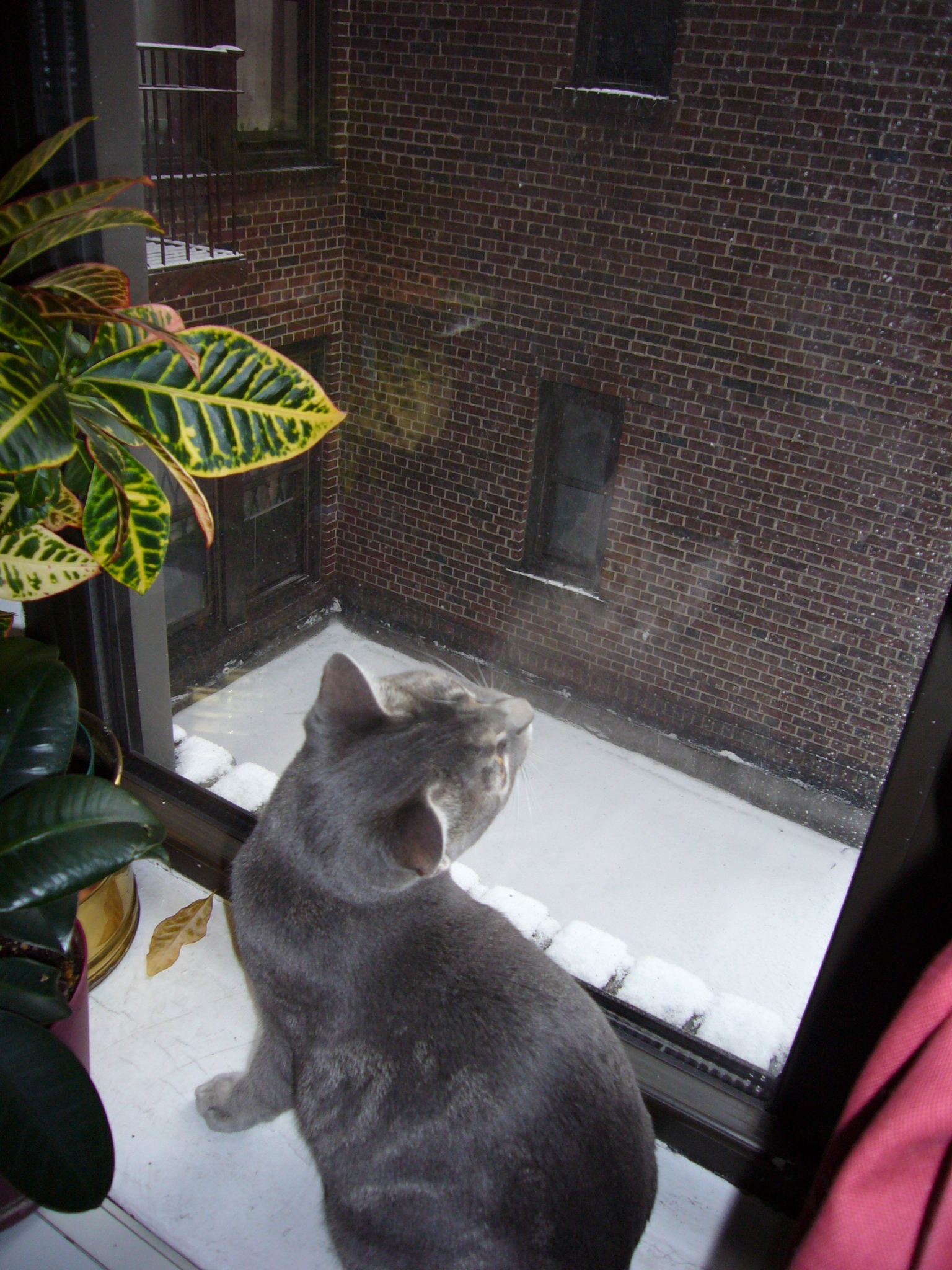
An honest-to-goddess snow storm—whoo hoo!

Last year, if you recall, New York shut itself down preemptively, announcing on Tuesday before a single damned flake fell that the entire world would be closed on Wednesday. Hmpf.

Well, there were a few reports on maybe Saturday or Sunday of a possible blizzard, but it didn’t seem like that big of a deal. Maybe because it was over the Christmas weekend, maybe because kids wouldn’t be in school anyway, maybe I just wasn’t paying attention, but there was little hysteria.

There was, however, snow, blowing, blowing snow.

Trickster was either fascinated or flipped out by the initial sputterings from the sky:

After awhile, however, she got bored, and did what she usually does: sleep.

Jasper yelped in response to the howling wind, and stretched out his body full-length trying to whap at the snow (by the time I got the camera out he was, of course, nowhere in sight). He did, however, helpfully interfere in my attempt to get a shot of the wind-sculpted drift in the corner:

Thanks, kitty-boy.

The wind was quite the artist, turning what would have been gently heaps of snow into mini-alpine ridges:

I generally try to get out after a big storm—not too many chances to wear my snow boots!—but a hangover from the flu made it unwise for me to attempt anything more physical than, mm, blogging.

(Oh, I did also try to enter my grades, due today, on Webgrade, but either something was wrong with my username and password or something was wrong with the system, and so I failed. The appropriate response, regardless? Fuck me.)

Anyway, I have heat and hot water and am not stuck in an airport or at Penn Station or on a train—apparently a couple of Queens lines, complete with passengers, were bollixed for hours—so despite the flu-crud, I was content to remain in my wee apartment and look at the big ol’ windy and wintry world through my windows.


Have yourself a merry little Christmas

24 12 2010

It’s a trifecta—no, a hat trick!—of blog thefts, this time, from the NYTimes.

“Worst Christmas Gift Ever“:

*A Harrah’s Casino coffee mug full of quarters given to me by my grandparents. The mug read, “Life begins at 21!” I was 9.

*One year my elderly great-aunt game me a box of straws and my sister received a tube of mustard. This remains a longstanding family joke nearly 60 years later.

*We received a can of haggis (yes, I guess haggis comes in a can) and a copy of the book “The Road.” It was quite the depressing Christmas.

*The worst as in destructive: My brothers sometime in the 1950s received an air gun and shot the ornaments off the revolving aluminum Christmas tree.

*When my sister was newly divorced for the second time and completely miserable, our mother gave her a cookbook called “Cooking for One” and some sort of individual crockpot to go with it.

*Dawn dish soap. I was 14. I guess somebody forgot to get me a gift, so they raided the cupboards. It was in a Happy Birthday bag.

*When I was 12, my mother gave me a wastebasket.

My Christmases tended to be pretty good, actually. There was always a little disappointment (where’s my pony?!), but my folks did what they could. One Christmas they bought my brother, sister, and I a combined gift: a t.v.!

We damned near hyperventilated as we unwrapped that gift.

And my mom’s side of the family has gotten into the habit of trading intentionally-crappy gifts with one another at their annual round-robin. Given this group’s wicked humor and delight in drink, well, it tends to be a very merry party.

So. Happy merry peaceful, to all and everyone.


Comment on a ‘no comment’

22 12 2010

Remember that nun in Arizona who was excommunicated for sanctioning life-saving surgery for a pregnant woman, surgery which resulted in the termination of her 11-week pregnancy?

Well, now the entire hospital has been disciplined, losing its official Catholic affiliation.

Bishop Thomas Olmsted called the 2009 procedure an abortion and said St. Joseph’s Hospital and Medical Center – recognized internationally for its neurology and neurosurgery practices – violated ethical and religious directives of the national Conference of Catholic Bishops.

“In the decision to abort, the equal dignity of mother and her baby were not both upheld,” Olmsted said at a news conference announcing the decision. “The mother had a disease that needed to be treated. But instead of treating the disease, St. Joseph’s medical staff and ethics committee decided that the healthy, 11-week-old baby should be directly killed.”

St. Joseph’s president Linda Hunt took the outrageous position that

“If we are presented with a situation in which a pregnancy threatens a woman’s life, our first priority is to save both patients. If that is not possible, we will always save the life we can save, and that is what we did in this case,” Hunt said. “Morally, ethically, and legally, we simply cannot stand by and let someone die whose life we might be able to save.”

It was precisely this attitude, as well as the unwillingness of administrators and doctors to promise never ever ever again attempt to save a pregnant woman’s life when that procedure might end the life of the fetus that led the diocese to strip its affiliation from St. Joseph’s.

Now that’s life.

h/t: Huffington Post


Every man, every man for himself

16 12 2010

I grew up with nuclear dreams.

Nightmares, actually: Watching as the bombs rained down, fleeing from bombs, living after the bombs fell, wondering how long before we were all gone.

I know that in real life that ‘bombs’ are unlikely—in most places, a single bomb would be enough—but these were nightmares, not journal articles. In real life, I studied nuclear history, nuclear weapons, nuclear tactics. I learned about throw-weights and multiple independently targetable reentry vehicle (MIRV) and ICBMs and SLBMs, tactical ‘backpack’ nukes, yields, and blast radii. I was drawn and horrified, thrilled and terrified at the technologies and policies that could end it all.

I was also convinced that any attempt to survive nuclear war was foolish, a waste of money, and, most damningly, likely to lower the threshold of MADness. Since deterrence was found in this balance of terror, any attempt to diminish that terror with songs of survivability was, itself, mad.

As regards all-out nuclear war, I think that assessment holds.

But what of smaller-scale nuclear war, of terrorist tactical nukes? The world won’t end if one or two or three bombs are exploded (see: the world after the Trinity test, Hiroshima, Nagasaki, and the numerous test explosions since 1945), so why not try to increase survivability?

Somewhat to my surprise, then, I am not opposed to federal guides on how to live after a nuclear explosion.

The New York Times notes that the Obama administration, following steps taken by the Bush administration, is distributing information on how to survive a nuclear bomb. This information is based on models which, unexpectedly, showed that casualties could be greatly reduced simply by taking shelter immediately after the blast, thereby reducing exposure to radioactive fallout.

Physicist Brooke Buddemeier spoke at a recent conference:

If people in Los Angeles a mile or more from ground zero of an attack took no shelter, Mr. Buddemeier said, there would be 285,000 casualties from fallout in that region.

Taking shelter in a place with minimal protection, like a car, would cut that figure to 125,000 deaths or injuries, he said. A shallow basement would further reduce it to 45,000 casualties. And the core of a big office building or an underground garage would provide the best shelter of all.

“We’d have no significant exposures,” Mr. Buddemeier told the conference, and thus virtually no casualties from fallout.

This is not nothing.

Government at all levels in the US is unreliable: it may come through in prevention before and care after, but, then again, maybe not. And, as these guides note, even a fully enabled government may not be able to respond immediately after.

For better and for worse, the government is telling us, we’re on our own. For better and for worse, we have to take care of ourselves.


I’m a rocket man

14 12 2010

I try to be good, get off the computer for a few hours, and what happens? I miss an entire conversation on science.

Well, goddammit.

(Actually, given that a large portion of the thread was given over to name-calling and trollist cavils, I guess I didn’t miss that much. Still.)

So, science. I am for it.

I am an epistemological nihilist, it’s true, so this support is caveated with the usual cracks and abyssals, but I’m also quite willing to hop right over those chasms to walk among the ruins that compose our human life—and one of our more spectacular ruins is science.

Yes, ‘our’. ‘Our’ because science truly is a human endeavor (even as its dogmatists assert that science can take us outside of ourselves), and as such, there to be claimed by all of us. And it is important to claim it, both against the dogmatists and against those who find nothing of worth in curiosity and rigor, or in experimentation, skepticism, and discovery.

I can only respond to those opposed to discovery with questions and fiction—as we do not inhabit the same world, argument is stillborn—but to the dogmatists and, it must be said, to those who favor curiosity and thus oppose science because they believe science poisons curiosity, I can offer history and reason and ruin.

To offer the whole of that argument is to offer a book; instead, here is the abstract:

We humans have sought to know, and in seeking, have sought to make sense of what we have found. How we make sense has varied—through recourse to myths, common sense, measurement, extrapolation, generalization, systematization, reflection, etc.—and what we make of the sense we make has varied as well. Sometimes we call it truth or religion or wickedness or allegory or interpretation; sometimes we call it science. Sometimes this science is the means, sometimes it is the end, sometimes it is both. In early modern times [in Europe], in the period now known as the Scientific Revolution, science was thought to reveal truths about God, as it also was by those scientists working under the Abbasids; that it also brought technological advance and political and economic gain helped to preserve it against those who argued that a thirst for knowledge was itself corrosive of the faith.

Yet even throughout much of the modern period science was understood as, if no longer an appendage of natural philosophy, as nonetheless a part of a constellation of knowledge which included the arts, literature, and humanities; its practitioners are all a part of the learned class.

This collegiality faded, and now science is understood primarily as comprising the natural sciences and its methods; to the extent some social sciences adopt those methods, they may or may not be admitted to the realm as sciences, albeit as its lesser, ‘softer’, version. That science has a history is barely acknowledged, and it is unclear if scientists (or their learned critics) would consider them as ‘intellectuals’ rather than (mere) technicians, experimentalists, and lab directors.

This separation (and, often, contempt) is lamentable all around. [Natural] science is more than its tools and methods, involves more [hermeneutic] interpretation than the experimentalists may admit of, and requires greater curiosity than its skeptics may allow. But if we want to know, if we humans truly seek a human science (and, again, I would argue there is no other), then we have to prevent science from sliding all the way into scientism. Some think it’s already so technics-shriveled, that it is already mere methodological fetishism; I disagree.

This saving gesture doesn’t require that artists now refer to themselves as scientists or that neurobiologists become novelists. No, this reclamation project (another ruin) would gather the curious back together, to see if we exiles from one another would have anything to say to one another, to see what we could see.

I don’t believe this every day—yesterday, for example, I had no patience for this.

But some days, some days I think we humans could do this. Some days, this is my something more.


Talkin’ ’bout my generation

9 12 2010

My blog-friend Mo at the Daily Snark has nabbed something which has been bothering, and eluding, me for a while:

I wonder if my focus is too broad. Or not broad enough. I’ve actually thought about abandoning this blog and maybe starting over. At one point I thought about starting a blog about dogs. I’ve even considered ditching blogging altogether. Which, truth be told, I don’t really want to do. . . . It’s been frustrating because I feel like I have to force myself into a niche but I don’t want this space to feel forced or contrived. I don’t want to make up a niche or a topic. I don’t want to be like some of the bloggers who are so entrenched in their niche that they can’t break free from it even though we know and they know they should have a long time ago. I like the freedom to write about anything and everything.

Yes: I want both focus and freedom.

When I started this blog, I had the idea of addressing philosophical and political matters in an accessible manner—intellectual journalism rather than academic scholarship, if you will. But I couldn’t keep my own self out of this blog, and the skew has turned much more personal than political.

I’m not terribly comfortable with that mix; however, I don’t think it’s a bad thing that I’m not terribly comfortable with that mix. I don’t think life is just one thing, and if I want, in my own uncertain way to ask about the meanings of life, well, things are going to be a bit of a mess.

And, as I commented to Mo, perhaps we should reject the niche in favor of the anti-niche:

We’re in the same generation—post-boomer, Gen-X—what I used to call the Un-Generation because, unlike the boomers, there seemed to be so little to tie us all together.

So why not go with that? This is who we’ve (uncollectively collectively) have always been. We could call it the ‘dishabille’ style. . . .

We’re thrown together (in oh so many ways), so it makes its own kind of sense that our blogs—our thoughts, our writings—would reflect that.

Besides, ‘dishabille’ sounds so much more dashing than ‘slacker’.


Lack Luster, Lack Luster how can I muster

7 12 2010

I am too much and not enough in my head.

Too much: I am pinned in my chair, un-able and un-willing to do what is minimally necessary to take care of my life, much less anything beyond that.

Too little: I have lost my concentration somewhere in a cascade of anxiety and passivity, un-able and un-willing to think myself past my self.

No, this isn’t a crisis—or if it is, it’s a low-grade one.

Anyway, the reason I bring this up is to note that this is happening, and to write that I won’t be writing much about this. I have to get some things straight with myself, and straightening is, frankly, boring for anyone other than the person undergoing the untwisting.

I remember when I was in the depths/throes/clutches/appropriatelyalarmingsynonymhere of my depression—I wrote and wrote and wrote about it, and little else competed with it. Once I got past the worst of it, however—once I was no longer nailed to Hamlet’s post—I gradually lost interest in noting every last blip in my emotion.

I’m not criticizing my past self—such self-monitoring was, in its own way, necessary; nor do I consider the loss of interest lamentable, as I am no longer so oppressed by my moods. The point, really, is that a record of the grind really only matters while one is being ground: after that, well, it was enough to be able to walk away.

That I’m a little ground down now is worth noting, but every damned detail of what I do to haul myself out, not so much.

I like writing this blog, and will continue to do so, but that this has become a place where I sort some things out doesn’t mean this is the appropriate forum in which to sort everything out.

But once it’s sorted? Oh, hell, I’ll jabber away.


On the occasion of emptying my mind and taking deep breaths and otherwise trying to make it through

6 12 2010

Or, my parents visiting:

It was fine.