Quick, breathe in deep

1 12 2010

My parents are flying in tomorrow for a long weekend visit.

My mind is a blank.

I like my parents, I do. And I respect them. I also recognize that on many levels we have little more in common than our genes.

Now, we do have enough in common—chattiness, a penchant for peanuts and beer, a basic degree of courtesy—that we can get along. From a distance of a thousand miles. Or for weekend visits in which I fly to them and then spend half of my time with other people.

But they’re coming here. Because I invited them.

Did I really think they’d come? After their last visit, they said, That’s our last visit. Of course, they drove, and stayed at a hotel in Queens that was near exactly nothing, and I’d only been in NY a short while and didn’t really know my way around, so it made sense that the trip was more hassle than it was worth. But once I moved into own new place—i.e., a place they could stay—it seemed to me that I ought at least ask them to stay.

See, that basic courtesy shit.

And they reciprocated. I don’t know that they really want to hang out in New York City. They see museums as a chore, aren’t into adventures in food, are not aficionados of the avant garde, and don’t really cotton to the idea of ‘just hanging out’ or ‘soaking it in’. No, they’re here to see me.

Again, that basic courtesy shit.

I don’t know what to do with them, and they most definitely are ‘doers’ (see: don’t just hang out). Thursday is set—they’re taking me to the Rockettes and then seeing another show while I teach—but Friday Saturday Sunday? I have no idea.

I sent them a long list of possibilities, figuring it would be better if they’d pick what they’d like to do, and then I’d go with them. Tenement Museum (they do like historical stuff), boat tours, tunnel tours—they haven’t said a word. I am afraid, very afraid, that they’ll want me to figure it all out.

If my folks were up for anything, this wouldn’t be problem. They are not up for anything.

So I’m thinking that we could hit the Craft Fair at St John the Divine’s on Friday, then they could, I don’t know, do something while I teach that night. Saturday, if it’s nice, we can walk through Prospect Park and maybe hit the Slope. Maybe we can dial up a movie to watch Saturday night.

Sunday? Christ. There’s a Packer bar in the West Village—maybe they’ll go for that. I don’t know what time their flight leaves on Monday; I hope it’s not too late.

That sounds terrible, doesn’t it? I’m girding myself for a visit from two people who love me, a visit I should be anticipating with joy rather than dread.

And so I am trying not to dread. Breathe in, breathe out. Empty my mind, empty my self. No fear, no dread, just being.

Breathe in, breathe out. Let it be, let it all be.


This heart was born feet runnin’

30 11 2010

I go to the gym to work out.

Radical concept, I know, but I remember how many people at the gym at the U of Minnesota apparently thought the weight machines and stationary bikes and stair steppers and treadmills were merely obstacles in their wanderings around the floor, saying ‘hi’ to friends, and checking themselves out in the mirrors.

There are people like that at the gym I go to now—you can find them most easily on the weekends—but as this gym is a pretty spartan and non-hip place, most of the folks are there for the same reason I am.

We’re all shapes and [adult] ages, and I’ve seen people with canes and wheelchairs maneuver themselves into the weight machines, so, again, this gym is serving its purpose as a place for people to get into or maintain shape.

All of this is a very long way of saying, Hey, I’m there to work out! Got it? Work. Out. That’s it.

Still. One of the benefits of hitting the gym is there are others there who are clearly much more dedicated to working out than oneself, and which results are apparent in these personages.

Great fucking shoulders, in other words. I have a weakness for, and thus pay attention to, well-sculpted shoulders. Yes, I have a general aesthetic appreciation for an athletic body, an appreciation tinged with the sadness that I am unlikely ever to manipulate my body into any category beyond the merely ‘fit’, but there is something about shoulders which gets me.

Yes, I am objectifying my fellow-gym-goers, gazing for perhaps a second or two too long at the gents doing pull-ups and otherwise taking note of the muscle-shirted men with the taut lines running up the forearms and over the biceps and rippling across broad backs. These men aren’t Mr. Universe, with muscle tumoring out of muscle, but regular guys with, jesus, beautiful, beautiful shoulders.

It’s so wrong. I’m there to work out, not to check out other people who are working out.

I mean, the treadmill should be enough to get my heart racing, shouldn’t it?


Thanksgiving for every wrong move

25 11 2010

It’d take about 20 minutes before our dresses would be off.

My cousin A. and I, having been forced to wear something nice (and constricting) for Thanksgiving, would head into the den and whip off our dresses so that we could play—hard. While our mothers might have sighed over the sight of us scampering about in our slips and tights, at least they didn’t have to worry about stains and tears to the good clothes.

All of us kids would head upstairs, carefully closing the door behind us—the better to keep the adults at bay—before tiptoeing through our grandma’s bedroom to reach the closet door.

This was a great closet, mainly because it was less a closet than a long, dark, narrow passageway into the other bedroom. Who had a closet like this? It wasn’t a secret, but it felt like one.

The real treasure, however, was the attic, which we were of course and repeatedly warned against entering. Come on: you tell kids ‘don’t you go messing around in the attic’ enough times and of course that’s exactly what we’re going to do. It was dark and drafty and a little bit dangerous (all those nails poking through the rough wood) and had just the right ratio of stuff to space: a great play space.

There was an old Victrola in the attic, and while I don’t remember if this was Thanksgiving or not, one year my brother and A.’s brother somehow got that thing cranked up and going; we all fled as sound came out of it, giddy and afraid we broke it.

No, we did not dare tell the adults.

Another favorite was to grab a blanket and ride it down the (carpeted) stairs. The door ended right at the last step—no space or landing—so every time you bumped down the steps you’d slam into the door. This would the lead the adults to ask What are you kids doing up there?

Nothing!

You’re not sliding down the stairs, are you?

No!

At some point my dad and uncles would grab a couple of glass jugs and head over to the nearest bar for beer, although it seemed to take them quite awhile to go just the few blocks and back. But they’d always return, in good cheer and carrying the soon-to-be-emptied jugs.

Finally, it would be time to eat: Adults at the fancy cherrywood table lengthened just for this day, the kids either at a card table set up near there or in the den. The den was best: We had our own bowls of food, and could take as much or as little as we wanted, but, really, we could laugh and mess around and not have to worry about ‘behaving’ or ‘keeping it down’.

We’d all crash out for a bit in my grandma’s small front room, my aunts and uncles smoking and us kids waiting until the cherrywood table was made small again and the adults gave permission for us to take over the (much larger) dining room. The blanket came back into play, usually in some manner of us rolling ourselves in it and trying to chase one another around. If one of the adults was sufficiently, ah, loosened up, he or she would join us, and perhaps we could get them to slide down the stairs, too—only this time, with the door open.

T.v. would be watched—there was usually some holiday movie on—and pie eaten. Other cousins who had eaten elsewhere might stop by, either for pie or beer, and we’d hang out until the traditional holiday walk.

Honestly, I don’t remember if this is something we did for Thanksgiving or Christmas or both (I think at least Thanksgiving), but we’d all bundle up and head out into the south Sheboygan neighborhood, a knotted string along shovelled walks. When we’d hit the highway the adults would call us close, then we’d climb the stairs to the bridge over the lanes. We got a nice shot of the lights of the neighborhood, and we’d wave at the oncoming cars.

And then we’d spit.

No, we weren’t (well, we weren’t supposed to be) aiming at cars. It was just our thing: We’d spit off the bridge.

So happy Thanksgiving, everyone. And may you get the chance where you are to spit off a bridge.


Whisper words of wisdom

24 11 2010

Allow a moment of sympathy for the Roman Catholic Church.

No, really.

The old girl is over 1500* years old, and the world now is not the world of its founding or expansion—a tough spot for an institution based on both spreading the Word and upholding eternal truths.  Yes, the One True Church has had to deal with interlopers and usurpers—in particular that centuries-long unpleasantness sparked by a disgruntled monk—but always, always, she has held true.

(*Given the un- and dis-organization of early Christian communities, a conservative estimate seems best. Oh, and for the purposes of this post, ‘the Church’ is defined narrowly as the institution, not the laypeople.)

Truth—ay, there’s the rub. Or, perhaps, insert the requisite LOLcats image here: ‘The Truth: I haz it.’

Consider the view of Archbishop Timothy Dolan of New York, newly elected preside of the US Conference of Catholic Bishops:

“You get the impression that the Holy See or the pope is like Congress and every once in a while says, ‘Oh, let’s change this law,’ ” he said. “We can’t.”

The key is to convince [would-be] parishioners of the Church’s position:

He said he was chagrined when he saw a long line of people last Sunday on Fifth Avenue. “I’m talking two blocks, a line of people waiting to get into …” he said, pausing for suspense. “Abercrombie and Fitch. And I thought, wow, there’s no line of people waiting to get into St. Patrick’s Cathedral, and the treasure in there is of eternal value. What can I do to help our great people appreciate that tradition?”

Hence the dilemma: We have this great tradition. . . that many reject.

The whys of the rejection are likely numerous—people don’t think the traditions are great, don’t think they’re immutable, don’t believe the Church is the best or only repository of those traditions, etc.—but that people are able to reject them means that those trying to sell the eternal value of those traditions have to figure out how to persuade the rejectionists to change their minds.

A number of commenters on the Dolan piece note that this amounts to a view of ‘Change your mind so we don’t have to’—a reasonable take on the Church’s position.

But those same commenters are also missing the point: the Church does in fact hold the position that there are eternal truths, that it is the guardian of those truths, and that to compromise on those truths is to call into question the point of the Church itself. Granted, some of those commenters are doing just that, but others seem to think that the Church simply needs to ‘get with the times’ when in fact the Church thinks it’s the times which need to get with the Church.

This is Ross Douthat’s view, expressed in his usual fuzzy, befuddled, obedient manner:

Here the Church struggles and struggles, in ways that it doesn’t on other controversial issues, to make its teaching understood and its moral reasoning transparent. . . . Orthodox Catholics sometimes argue that the problem is simply that the teaching hasn’t been adequately explicated and defended, whether by bishops or priests or laypeople — and there’s truth to this. But the problem probably runs deeper than that: It isn’t just that the arguments for the teaching aren’t advanced vigorously and eloquently enough; it’s that the distinctions that the Church makes bump up against people’s moral intuitions more than they do on other fronts, and the Church’s arguments often take on a kind of hair-splitting quality that’s absent on other hot-button questions. (As in: The natural law permits me to rigorously chart my temperature and/or measure my cervical mucus every day in an effort to avoid conception, but it doesn’t permit me to use a condom? Really?)

So Douthat sees that even those who generally follow the Church’s teachings nonetheless squint at the reasoning behind the pronouncements on Truth—in this case, the anti-contraception Truth. Thus, should these same laypeople follow their own reason to the Truth?

Not exactly:

Now for a serious Catholic, the argument from tradition and authority is a real argument, not just the dodge that many people assume it to be. And the fact that the Church’s moral reasoning seems unpersuasive may just reflect the distorting impact of a contraceptive culture on the individual conscience.

Again: the problem, dear (un)believer is with you.

But what if the Church does try, however fitfully, to make practical sense of its moral stance in an im- or a-moral world, as with condom use in paid-for sex? You get it from all sides, from those of us skeptical of the morality of its stance to those who consider it an impermissible detour from the straight and narrow.

John Haas, president of the National Catholic Bioethics Center and a moral theologian, urged the publisher not to publish the Pope’s book, Light of the World, arguing it would only create a ‘mess’. That a Vatican spokesman later clarified that the Pope’s comment related not just to male but also to female prostitutes, was almost unbelievable, given the implications regarding contraception:

Indeed, Dr. Haas, of the National Catholic Bioethics Center, could barely countenance Father Lombardi’s comments that broadened the debate to include women. “I don’t think it’s a clarification; it’s a muddying of the waters,” he said. “My opinion is that the pope purposely chose a male prostitute to avoid that particular debate.”

And if Benedict was in fact opening that debate? “I think the pope’s wrong,” Dr. Haas added.

Well.

The Church has to hold the line because, were any slack allowed, the meaning of the line would cease, as would that of the Church itself. Yet not to loosen the line means that people will flee, if only to save themselves from suffocation—and in so doing, to call into question the meaning of the line and that of the Church itself.

It is a true dilemma, and for that reason, I am sympathetic.

But—you knew I’d throw a ‘but’ in—the Church itself is the author of this dilemma. It set itself up as the One True Church, the path to salvation, the authority on all matters God, so much so that authority itself was reified. The point of the Church became the Church.

This is, of course, an ancient dilemma, one which runs through the history of not just Church but Christianity itself. Early dissenters (including Pelagians and some gnostics, among others) argued that God was carried within and thus no formal structure was necessary; a thousand or so years later protesters lay the Bible before the people and told them that was all they needed. (That those Protestants set up their own structures is another issue.) Sola fidelis, sola scriptura.

But the Church, the Church said No. The Church said We are the One True Faith. The Church said, in effect (if anachronistically): Who you going to believe? Me or your lying eyes?

The Church, in other words, rested the faith on its authority, rather than its authority on faith. In doing so, the truth of the authority calcified into the Church’s Truth and, as such, could be neither compromised or countermanded. The Church is the repository of God’s Word, its guardian and keeper; to doubt this authority is to risk losing the keys to the Kingdom itself.

This risk has kept many inside, as, I hasten to add, have faith and love for the Church itself. But those on the outside, especially those faith-seekers on the outside, see the lines and the walls of the Church and wonder Where is God in all this?


Wrap it up

21 11 2010

Pope Says Condoms to Stop AIDS May Be Acceptable

-headline in New York Times story on the pope recognizing that people are. . . people.

Well, some of us, perhaps:

“There may be a basis in the case of some individuals, as perhaps when a male prostitute uses a condom, where this can be a first step in the direction of a moralization, a first assumption of responsibility, on the way toward recovering an awareness that not everything is allowed and that one cannot do whatever one wants,” the pope said.

That’s nice.

It’s a fine thing to recognize that the lives of gay men are worth saving. And Sullivan points out that by so recognizing the worth of said lives, the Pope introduces the possibility that gay men who have sex may act in a manner not completely outside of the moral sphere:

[O]nce you introduce a spectrum of moral choices for the homosexual, you have to discuss a morality for homosexuals. Previously, it was simply: whatever you do is so vile none of can be moral. Now, it appears to be: even in a sexual encounter between a prostitute and his john there is a spectrum of moral conduct.

Again, most excellent, not least because it allows for the possibility, however slim, that long-term gay male relationships may someday be recognized as morally licit.

Sullivan then goes on to note that this stance actually favors gay male relationships:

It’s okay for a gay prostitute to wear a condom because he was never going to procreate anyway. But for a poor straight couple in Africa, where the husband is HIV-positive and the wife HIV-negative, nothing must come in the way of being open to procreation … even if that means the infection of someone you love with a terminal disease.

It’s then you realize that the Vatican’s problem is not just homophobia. It’s heterophobia as well.

Dan Savage pushes the point a bit further:

So… condoms are okay when they’re being used to protect men who see male prostitutes. They’re not okay when they’re being used to protect a woman—a woman who might already have more kids than she can possibly feed—from an unwanted pregnancy or a sexually transmitted infection.

Allow me to push this all the way over the edge: Is there any recognition of women, any sense that we might have any say at all in our own sexual or moral lives?

Okay, so this is just an excerpt from Il Papa’s forthcoming book—maybe he’s got a whole chapter about the intellect and worth of those of us who wear our generative bits (most decidedly not ‘junk’) on the inside—but I gotta be honest with you, I’m thinking: no.

‘Heterophobia’ might work for Sullivan, but I’m old school: I think I’ll stick with the more traditional ‘misogyny’.


I was so much younger then

16 11 2010

I need an image.

No, not for me—I have my lovely red cube—for my first novel.

I really slacked off on the editing, but it’s done, now. For the most part. One last walk-through. . . .

Anyway, I should be able to post it to Smashwords say, oh, around Thanksgiving, and I’d really like it to have a ‘cover’, and, given that the novel is neither abstract nor experimental, an abstract or experimental image wouldn’t work.

So a photo, or a drawing, something which has some relationship to the setting of the novel itself. I sketched something out, but, well, there’s a reason I work in words. Then I tried searching for images of what I’d want, thinking I could just pony up a licensing fee, but, eh.

Then I thought, Huh, I wonder if I’ve got something which could work in my photo bin. So, after hoisting Tricks and then Jasper out from the pile of photos, I dove into my past.

There are my nieces and nephew as babies. My sister with a perm. My brother with hair. And, jesus, that short-sleeved green shirt I still love? Apparently, I bought that in high school, as there’s a shot of me wearing it in the high school theatre makeup room. There’s K. and M. and me in our costumes from Mame, and, ho, there I am, in a bikini at the quarry.

No, I won’t be posting that one.

I just bought some film for my old Olympus, but, really, most of my shots these days are digital. Will it be the same, in ten or twenty or thirty years to flip through my computer (or online or whatever) archive and see shots of the kitties or my apartment or snow on the fire escape?

Maybe. It is the image, primarily, which pulls me back, and that’s what I’ll see. But I can also tell the different cameras I used in the film shots, the kind of film, the matte and glossy finish. And while I regularly delete bad images from my digital chip, I kept a lot of the old bad film shots—hey, I paid for those!

I’m not slagging the digital, and who knows, in twenty years digital may be old school.

But I’ll never be as young as I was on film.


Hey you might need a raincoat

10 11 2010

I have too much stuff.

This is something I recognize every single time I move, but in my half-employment, I’ve been trying to spiff up my apartment (painting not just desks but also bookcases! and other things!), a spiffing which requires that I get rid of stuff.

But the problem(s), see, is that 1) some stuff is useful; and 2) I hate waste.

On the useful stuff: I’ve lived with roommates who’ve laughed at all the stuff I have but who also have had no problem making use of said stuff. Television (now gone, of course). Pots. Pans. Knives. Dishes and kitchenware, generally. They’d put garbage in the garbage cans I brought with me, swept their rooms with my broom, and as far as I know were quite happy that there were lights in the living room.

No, no resentment. None. at. all.

So when I would pack up all of my stuff I’d think Oy, too much stuff, but then I’d think, What are you going to do? If I wanted to be able to cook and eat and clean and be able to read then I’d need pots and pans and dishes and brooms and lights and really, since I already owned all of this stuff, didn’t it make more sense for me just to bring it with me than to toss it out and buy new stuff?

Which brings me to the second point, hating waste. If I think something could be useful, I tend to keep it around. I grew up in a house in which half of the basement was given over to storage, as were both attics. My parents were in no ways pack rats; they used the stuff they kept in the basement and attics—that’s why they kept it—and I’ve picked up that habit of, say, saving old jeans in case I need the fabric, or of clipping off buttons and zippers of clothes too far gone to be worn, or jars for storage, or keeping scraps of wood for. . . who knows?

The attic off my sister’s and my bedroom held my dad’s old Air Force duffel bag and the Christmas ornaments, but the attic in my brother’s room held, well, boxes. My mom kept boxes of boxes because that shirt you purchased from Prange’s or JC Penney’s might not have come with a box, and if you want to give it as a gift wouldn’t it look so much nicer wrapped in a box?

So at Christmas time or at any birthday, boxes would be collected and saved for reuse, as were, for a number of years, bows. (We once saved all the Christmas wrapping because my mom heard that it that it made for multicolored flames in a fire. It did not, and thus every year thereafter someone would say ‘We should keep this wrapping for camping. . . .’ My mother did not always find this amusing.)

And, of course, plastic containers were saved, if not for food, then to keep in order the misc bits floating around my dad’s tool bench or if one needed a container for paint or stain or, again, whatever.

My folks weren’t maniacs. Once things were well-used or worn out, they got tossed. In fact, this could be one of the benefits of re-use: Why bother scrubbing the stain out of that old plastic container: just toss it. Or these things could be brought to a picnic or camping or on vacation, with the idea that if the thing were lost or damaged, oh well.

It’s not like losing the good Tupperware.

I don’t have a house or basement or even one, much less two, attics. But I do have a bin of fabric, and I’ve constructed more than one bookshelf or container out of found wood. I have a box of buttons and a few slashed-out zippers and right now there’s a pair of old jeans sitting on top of my bicycle that are too beat to donate and I already have enough jean fabric so I should really just toss them but then again. . . .

Oh, and have I mentioned that I own two bicycles? One is a road bike, circa 1991, and the other a mountain bike from 1994. I don’t really need two bikes—I could get by with the mountain bike—but I doubt I’d get much money for the road bike and jesus it really is a sweet ride and I’m not a serious enough biker to toss out a thousand bucks for a new bike if I want to do some long-haul biking and I already have this one. . . so why not keep it?

The books? Forget it: lost cause.

The files—yes! the files! I have gotten rid of a lot of those, and if I get off my ass will get rid of even more. The conceptual shift away from keeping these has been made; now the practice needs to catch up.

But what of the stuff I keep just because? I have a bin of photos and a box of letters and I don’t think I’ll ever get rid of either, because I can replace neither. I rarely go through them, but I like that they’re there. (And it’s just two containers, one under the bed and one in the back of a closet. Out of sight. . . .)

There’s also a third issue, the storing-up stuff. Again, this is a habit learned in SmallTown: Whenever something our family used went on sale, my mom or pop would stock up. Too much toilet paper? Just put it in that space above the regular closet. Extra peanuts (we were a big peanut-eating family) or cans of corn would go on the shelves in the basement, as would the cases of beer and soda.

I don’t need to tell you that we had a freezer and an extra fridge in the basement, do I?

The point was never to run out of stuff. If you need a band-aid or some tape an envelope or toothpaste then it damned well better be there. There was no excuse to run out of stuff which could be stored.

In my household, this means there are always back-up bars of soap, bottles of shampoo, dish soap, and getting down to only 2 or 3 rolls of toilet paper is, if not a crisis, something which requires immediate attention. And don’t ask about the feminine hygiene products.

The upshot of all of this is that my practical habits and my preferences clash: I want a clear space, and prefer emptiness to clutter. I also hate waste and want to make sure the basic are covered.

If only I had an attic.


The monster mash

8 11 2010

Zombies give me nightmares.

Actually, scratch that: zombies onscreen give me nightmares. I read and enjoyed Max Brooks’s World War Z and have sketched out a short ‘story’ (basically, a fake journal article on zombies)  and nary a blip in dreamworld.

But put a zombie where I can see it? Shudder.

I don’t know why. I mean, in 28 Days Later—which jolted me out of my sleep for a week after, and then sent me lurching awake a full six months after viewing—what shocked was not the zombies (and really, not zombies, but rage-virused monsters) but the people. That military commander? The thought that one would become the rape-thing to a bunch of despairing soldiers?

Jesus, at least the monsters were just hungry, not evil.

And in the new show The Walking Dead, again, the forewarning that the problem will be with the people, not the zed-heads.

That’s what set this post off—the premiere to The Walking Dead. I watched it early yesterday evening on Hulu, figuring that gave me enough time before bedtime for me to forget it, but: no.

It wasn’t that scary, honestly, certainly not in comparison to 28 Days Later. And afterward, I thought, Eh.  Too soap-opery, too predictable, too somber, not scary enough. And the lead? Okay, so he needs to wear his sheriff’s outfit to keep himself in line, but is he really this innocent?

Dumb, actually. Or maybe not dumb, but not thinking. He needs gas, all those cars on the road, and he leaves the road to walk some ways to a gas station, which—surprise!—is out of gas.

He never heard of a siphon?

Then he ditches the car in favor of a horse, because, let’s face it, nothing makes more sense than leaving behind a steel-and-glass contained space (with storage!) for a pretty pretty equine bit of zombie bait.

Maybe if it all moved faster, carried some of the jangle that good B-movies like 28 Days Later or even the nausea-inducing Cloverfield managed to convey, I could enjoy rather than pick apart the predictability.

But nightmares for the boring? No thanks.

~~~~~

I should add that I enjoyed Shaun of the Dead, and that since it’s been so long since I’ve seen any of George Romero’s movies, I can’t remember if those gave me nightmares.

Anyway, it’s not just zombies. The Ring creeped me out, and I vowed never to camp in Maryland after The Blair Witch Project. Oh, and I recently made the mistake of watching the mediocre Event Horizon before bed—not a good idea.

I’m not generally a scary- or horror-movie aficionado, and have little patience for spatter movies, but I do enjoy a well-crafted bit of unease. (Okay, enjoy may be the wrong word; appreciate, perhaps?) The Others wasn’t scary, and even a bit somnolent, but I liked its meditative vibe.

The Sixth Sense and Signs? No.

I don’t recall any nightmares following The Road, but, then again, I don’t know that that would count as a horror film. It’s full of horror, true, but perhaps one reason my response was dulled was because I knew nothing would get better. The hope or possibility of escape or reprieve was gone, as with it the altertness that one holds on behalf of the characters. It was the end, that’s all, and I was sad for the characters, that’s all.

I had nuclear nightmares as a teenager, but as I had been experiencing those prior to seeing The Day After or Testament, I blame the miasma rather than the movies.

No, my worst nightmares when young were unrelated to anything I saw on t.v. or at the movie theatre—likely because my parents didn’t let me watch scary flicks. I’d already demonstrated the, ah, ability to scare myself shriekingly awake (Over vents. Don’t ask.), so I’d guess that they thought ‘Why tune her up even more?’

Still, there was that one episode of The Outer Limits, wherein the woman tried to vacuum up something in the corner. . . .

That probably set me off, too.

~~~~~

Still, I’m not eight and I don’t believe in zombies. In fact, I consider nuclear or environmental or even cosmic apocalypse, however unlike in my lifetime, still more likely than a zombiepocalypse. So why the scare at the latter and not the former?

Maybe because I don’t consider it likely at all, and thus don’t have the rational responses to the truly fantastical (the undead) that I do to the merely improbable.

Maybe there’s something about the uncanniness of the zombie: to be dead, but still restless, ravenous, recognizably human but demonstrably not.

Or maybe because I just keep watching these @#$!!$% zombie movies too close to bed. . . .


Today is Tuesday, today is Tuesday

2 11 2010

So, yep, it’s Tuesday. The first Tuesday in November. The first Tuesday in November in an even-numbered year.

Huh.

I’m celebrating the first Tuesday in November in an even-numbered year by painting my desk.

Actually, the desk was a table before I put a computer and a bunch of books on it. I bought it when I lived in Somerville and had a HUGE kitchen—and was still under the delusion that I might someday have lots and lots of friends in the Boston area and we’d all congregate regularly in my gorgeous apartment with its HUGE kitchen.

Anyway. It was sometimes stored and sometimes used as a table in New York, and after I failed to sell it, I figured I’d bring it with me to this apartment and use it as a desk.

It’s fine as a desk. The height’s a bit awkward vis-a-vis the arms on my chair, but that’s manageable. The truly great thing about it is that I can store a bunch of office-related stuff underneath it and out of site.

But the color, sigh, the color.

I had stained it lo those many years ago, and was never happy with the stain. I was going for something warm and not too dark; I ended up with. . . orange.  Well, not orange exactly, but definitely orange-ish.

I ougtta paint it, I thought.

And did nothing.

Then the thought would come around again: I oughtta paint it.

And nothing. It’s really dark in that corner; painting the desk would really lighten things up. Nothing.

Repeat repeat repeat.

But now! This first Tuesday of November in an even-numbered year and when I am only half-employed—now would be a fine time to paint it!

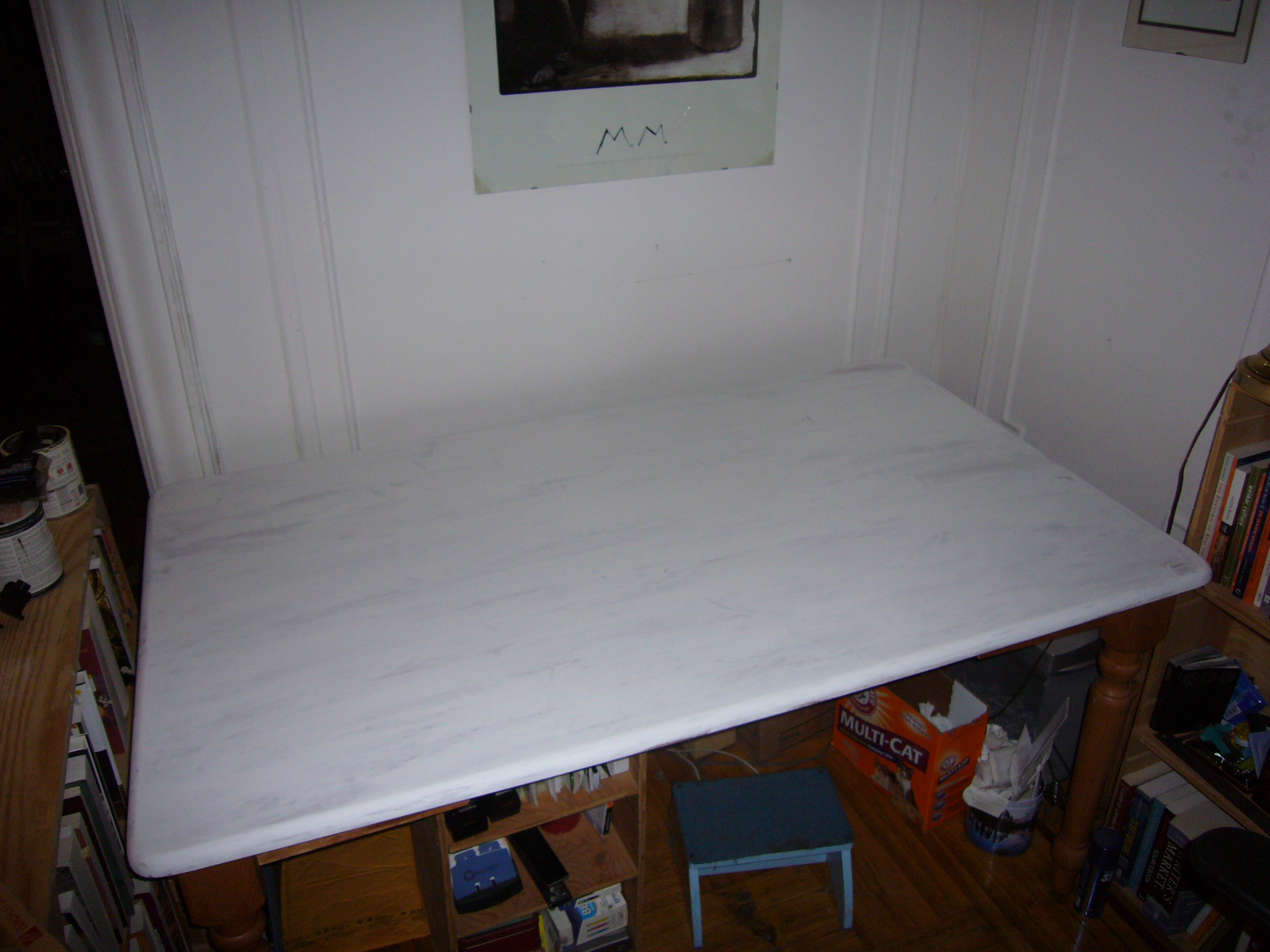
So when I got home from my very slow run through Prospect Park, I sanded down the top and primed it. Ta da!

Primed and ready!

Terribly exciting, I know. Almost as exciting as creating a large space of wetness with two kitties around.

(And no, I don’t keep the cat litter under the desk: I use the box as a makeshift garbage can. ‘Cause I’m cheap thrifty like that.)

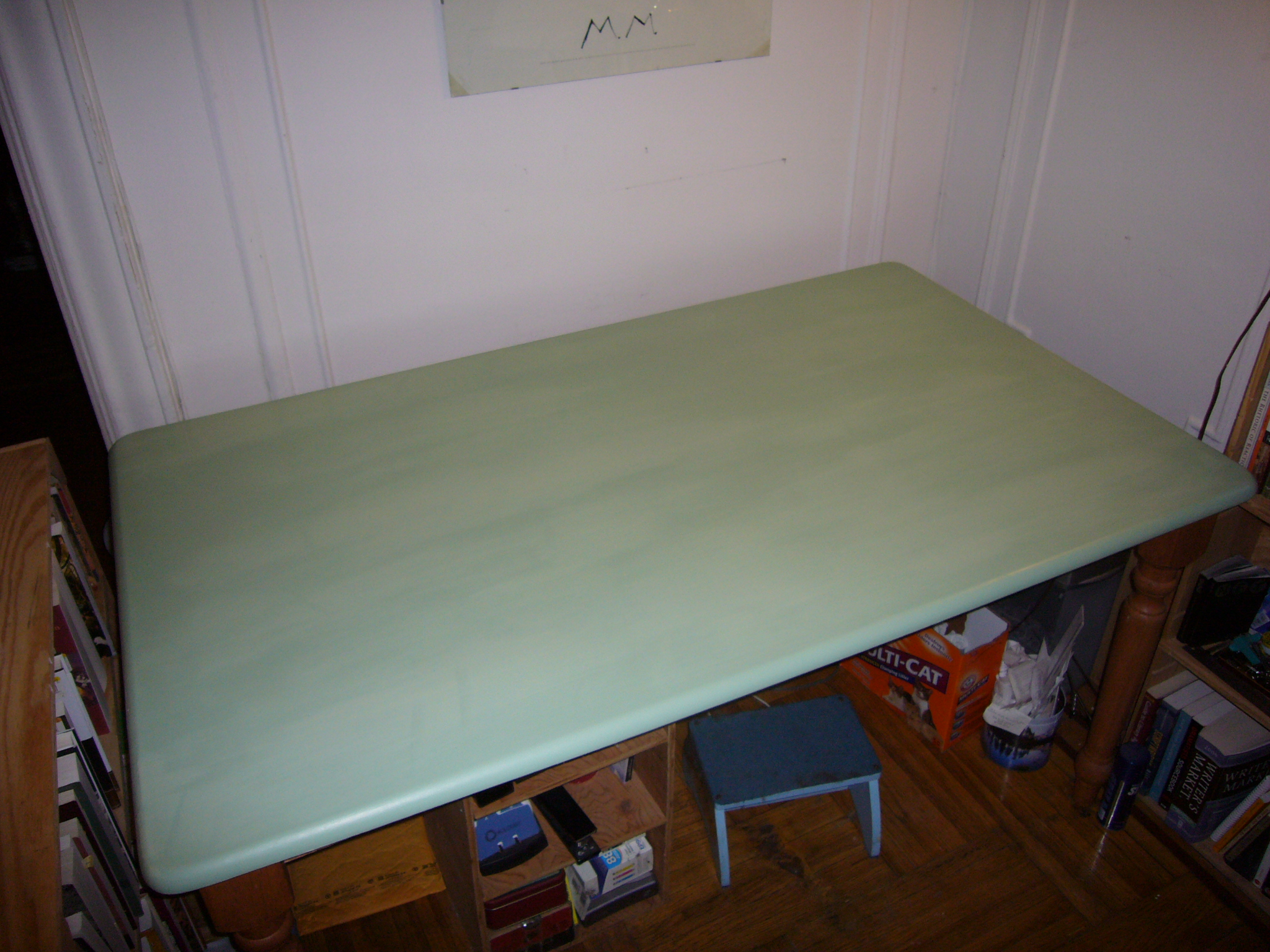
I’m going for something very light green—not mint (flashback to bad bridesmaid dresses)—but more olive or apple-y. I’ll see what I can manage with the paint I have.

Yup. It's painted.

It’s not yet dry, and I intentionally didn’t mix it thoroughly, so it’s a bit streaky.

If I can keep the cats off it for the next half hour or so, it should be fine.

So that’s what I did on the night of the first Tuesday in November in an even-numbered year.

Watched paint dry.


Let’s call the whole thing off

31 10 2010

Oh god, another election.

I can’t listen to the radio—I was glad that last week was WNYC’s fall fund drive, which meant continual (and amusing) Alec Baldwin interruptions—and skim over any and all election forecasts, punditry, analyses, and general media wankery about What This Election Means.

What This Election Means? It’s a midterm election following an historical presidential race (which itself followed a terrible two-term presidency) and occurring amidst a recession.  Marginal seats picked up two years ago get lost, and high unemployment tends to leave voters with a throw-the-bums-out sensibility.

What It Means: Duck Duck Goose.

You would prefer A Referendum on The President? Maybe. Whatever. A meaningless conjecture, insofar as Obama is not up for reelection this time around, and because the man has two years in which to spiff himself up and make himself all attractive again to voters.

I know all this; so why am I particularly down on this round of elections?

Because my side is gonna lose big? Pfft, I’m used to losing, and these Dems are not so much ‘my side’ as they are actively not-against me. That’s nice, and valuable, but with the exception of Russ Feingold, that bitter little heart I mentioned two posts ago ain’t gonna break for the loss of any of ’em.

No, I’m just old. Or I started bingeing on politics at too young an age, and now I have, finally, had enough.

I remember Reagan’s election—oh, hell, I can remember Nixon’s election in ’72, but I don’t recall having any particular thoughts about it at the time—and remember thinking Oh, This Is Very Bad.

And his second election? Not a surprise, but a blow, nonetheless. That was the first campaign I worked on, the first one which I experienced close-up: I was part of the crew which helped prep a huge Mondale/Ferraro rally on the steps of the Capitol in Madison. Every moment not in class I was at campaign headquarters, and I worked hard enough and long enough and smart enough to earn a ‘backstage’ (actually, off-limits areas of the Capitol) badge.

SmallTown hick working Big Time politics. Exhilarating.

Then, the morning after the rally, I got on a bus to take part in an anti-nuke march in Chicago. Didn’t know a soul there, so I was able to sidle up by myself to the stage and listen to Jesse Jackson and Helen Caldicott (and my memory says Petra Kelly but I think my memory is imagining things) and take in the muted misty day.

Then, the day after that, I got on a bus to Milwaukee to hear Gloria Steinem speak.

Hell of a weekend.

And probably the high point of my political involvement. I have attended other rallies (including two tits-freezing anti-war marches in Montreal in 2003) and worked on other campaigns, but I was never so involved as that semester of college.

Okay, there was the time we marched down Bascom Hill and into the Capitol to protest the state’s investment in companies that did business in South Africa and ended up occupying the rotunda for two weeks, but even then, I didn’t sleep there the entire time (marble is cold and uncomfortable).

No, I started pulling back even in college, and with the exception of two (failed) union drives in grad school, even more so in grad school. I had been aghast when an undergrad pol sci prof mentioned that most political scientists aren’t that interest in politics; now, I was beginning to understand.

I did give it one more go, tho’: In the run-up to the 2004 election I felt like I had to do something, so although I loved Montreal and had the chance to extend my post-doc, I said, No, I can’t be on the sidelines for this election: I gotta go back to the States and campaign.

Which I did. And which I hated. And which, of course, came to naught.

(I sometimes wonder if part of my disdain for Boston is a cover for my own self-contempt for making the stupid decision to leave my beautiful Montreal labyrinth for the dull and crabby snarl of The Hub. Christ.)

So now? Now I vote, because, you know, I should vote. And I pay attention because, you know, I should pay attention.

I’m in my forties and I’ve been voting and paying attention for thirty years and I’ll keep voting and paying attention for the next forty or thirty years.

It’s just that that used to excite me; now it just wears me out.

(h/t to BenjaminTheAss, who hasn’t given up.)